AI Advertising in 2026: What Actually Works Now
{
  "@context": "https://schema.org",
  "@type": "BlogPosting",
  "@id": "https://mattkundodigitalmarketing.com/blog/ai-advertising-guide-2026/#article",
  "headline": "AI Advertising in 2026: What Actually Works Now",
  "description": "Cut through the AI advertising hype for 2026. Get the platforms, trends, and a practical rollout plan to lift ROI without the common pitfalls.",
  "image": "https://mattkundodigitalmarketing.com/assets/images/blog/ai-advertising-guide-2026/hero.jpg",
  "datePublished": "2026-01-12",
  "dateModified": "2026-08-05",
  "wordCount": 1920,
  "articleSection": "Paid Media",
  "keywords": [
    "ai advertising",
    "artificial intelligence advertising",
    "artificial intelligence advertising solutions",
    "ai marketing companies"
  ],
  "author": {
    "@type": "Person",
    "@id": "https://mattkundodigitalmarketing.com/about/#matt-kundo",
    "name": "Matt Kundo",
    "url": "https://mattkundodigitalmarketing.com/about/",
    "jobTitle": "Marketing Consultant"
  },
  "publisher": {
    "@type": "Organization",
    "@id": "https://mattkundodigitalmarketing.com/#organization",
    "name": "MKDM",
    "logo": {
      "@type": "ImageObject",
      "url": "https://mattkundodigitalmarketing.com/assets/images/mkdm-logo.png"
    }
  },
  "mainEntityOfPage": {
    "@type": "WebPage",
    "@id": "https://mattkundodigitalmarketing.com/blog/ai-advertising-guide-2026/"
  },
  "speakable": {
    "@type": "SpeakableSpecification",
    "cssSelector": [
      "h1",
      "h2",
      ".article-summary",
      ".key-takeaways"
    ]
  },
  "about": {
    "@type": "Thing",
    "name": "AI advertising"
  },
  "mentions": [
    {
      "@type": "Organization",
      "name": "Matt Kundo Digital Marketing",
      "url": "https://mattkundodigitalmarketing.com"
    }
  ]
} AI advertising isn't just coming, it's already here, reshaping how businesses connect with customers in ways we couldn't have imagined a few years ago. Whether you're a small business owner wondering if this tech is worth your time or a marketing pro looking to level up your campaigns, this guide breaks down everything you need to know about artificial intelligence advertising in 2026.
AI advertising uses artificial intelligence and machine learning to automate, optimize, and personalize digital advertising campaigns. From AI-powered creative generation to automated bidding and audience targeting, these technologies help businesses achieve better ROI while reducing manual effort. In 2026, AI advertising has evolved from simple automation to agentic systems that can plan, execute, and optimize entire campaigns with minimal human intervention.
Table of contents
What is AI advertising?
AI advertising refers to the use of artificial intelligence technologies to create, manage, and optimize advertising campaigns across digital channels. This includes machine learning algorithms that analyze data patterns, natural language processing for ad copy generation, and computer vision for creative asset production.
The core difference between AI advertising and traditional digital advertising lies in automation and optimization. Traditional campaigns require manual adjustments to targeting, bidding, and creative elements. Artificial intelligence advertising solutions automate these processes by analyzing vast amounts of data in real-time and making adjustments that would take human marketers hours or days.
According to industry reports, the global AI in marketing market is projected to reach $100-150 billion by 2030, with compound annual growth rates exceeding 25%. This growth reflects a fundamental shift in how businesses approach digital marketing expertise.
Key components of modern AI advertising include:
- Machine learning for predictive audience targeting
- Natural language processing for automated ad copy generation
- Computer vision for image and video optimization
- Programmatic advertising with real-time bidding
- Marketing automation for campaign orchestration
The evolution from rule-based marketing automation to true artificial intelligence advertising represents a paradigm shift. Rather than following pre-set rules, AI systems learn from campaign performance data and continuously improve their targeting and optimization strategies.
Why AI advertising matters in 2026
The advertising landscape in 2026 presents unprecedented challenges that make AI advertising essential rather than optional. Privacy regulations have fundamentally changed how advertisers can target audiences. Cookie deprecation has forced the industry to develop new approaches to reaching the right customers.
According to the IAB, over 70% of marketers have encountered an AI-related incident in their advertising efforts, including hallucinations, bias, or off-brand content. Yet less than 35% of marketers plan to increase investment in AI governance or brand integrity oversight. This gap highlights both the urgency and the complexity of artificial intelligence advertising adoption.
Consumer expectations have also shifted dramatically. Today's audiences expect personalized experiences delivered at scale. Contextual AI advertising and privacy-safe targeting have become critical capabilities as third-party data becomes less accessible.
"In a zero-click world, the conversation between consumers and an AI agent is the new first impression ... AI Visibility will become a boardroom level priority for all brands by 2026."
. James Cadwallader, Co-founder and CEO of Profound
The competitive landscape has intensified as well. Major brands have integrated AI marketing companies and tools into their core operations. Businesses that fail to adopt artificial intelligence advertising solutions risk falling behind competitors who can optimize campaigns faster, personalize at greater scale, and reduce wasted ad spend through predictive analytics.
How AI advertising works
Understanding how AI advertising works helps marketers leverage these systems effectively. At its core, AI advertising operates through several interconnected capabilities that work together to optimize campaign performance.
Audience targeting and segmentation
AI-powered targeting analyzes behavioral patterns, purchase history, and contextual signals to identify high-value audience segments. Unlike traditional demographic targeting, machine learning models can identify patterns humans would miss. These systems continuously refine targeting based on campaign results, creating a feedback loop that improves performance over time.
Automated bidding and budget optimization
AI advertising platforms use predictive algorithms to determine optimal bid amounts for each ad auction. According to industry research, AI tools can predict results before spend is committed, helping teams move faster with less risk. This capability transforms how marketers allocate budgets across channels and campaigns.
Creative generation and testing
Generative AI has transformed ad creation workflows. These systems can produce ad copy variations, image concepts, and video ads at scale. More importantly, they enable rapid testing of creative elements to identify winning combinations faster than manual processes allow.
The integration with marketing automation systems enables end-to-end campaign management. AI handles the optimization while marketers focus on strategy and creative direction.
Performance prediction and real-time optimization
Modern AI advertising platforms analyze campaign data continuously and make real-time adjustments. This includes shifting budget to high-performing ads, pausing underperforming creative, and adjusting targeting parameters based on conversion patterns.
According to eMarketer research on AI marketing infrastructure, organizations implementing AI-powered advertising optimization see significant improvements in both efficiency and effectiveness.
Top AI advertising platforms and tools
The AI advertising ecosystem includes major platform solutions, specialized optimization tools, and creative AI applications. Understanding the landscape helps marketers select the right artificial intelligence advertising solutions for their needs.
Major platform solutions
Google Performance Max represents Google's most advanced AI-driven campaign type. It uses machine learning to optimize ad delivery across Search, Display, YouTube, Gmail, and Maps from a single campaign. The system automatically generates ad combinations and allocates budget based on performance signals. While AI handles optimization, foundational paid search best practices remain crucial, for comprehensive strategies on remarketing, click fraud protection, competitor targeting, and more, see our complete guide to paid search tips for high-performing campaigns.
Meta Advantage+ brings similar capabilities to Facebook and Instagram advertising. The platform automates audience targeting, creative optimization, and placement selection. For businesses running social advertising, Advantage+ simplifies PPC campaign management while improving results.
Microsoft Advertising Copilot integrates generative AI directly into the campaign creation workflow. Advertisers can describe their goals and receive AI-generated campaigns optimized for Bing and partner networks.
Specialized AI advertising tools
Albert.ai operates as an autonomous digital advertising platform that personalizes and optimizes ad content at scale across Facebook, YouTube, Google Ads, and Bing to improve ROAS. According to industry reports, major brands like Shopify, Instacart, and Airbnb use AI marketing companies and tools internally to gain competitive advantage.
Jasper focuses on content and copy generation for advertising, offering agentic workspace capabilities for marketing teams. Typeface, which raised $100M in Series B funding in 2024, provides enterprise-scale generative AI for brand-consistent content creation.
AdCreative.ai and Creatify.ai specialize in AI-powered ad creative generation, enabling rapid production of ad variants for testing.
Creative AI tools
For visual content, tools like Midjourney, DALL-E 3, and Adobe Firefly enable marketers to generate custom imagery for campaigns. Runway and Pika Labs extend these capabilities to video ads, making video production accessible to teams without traditional production resources.
In my view the real gain from these tools is time. When AI handles the variant production and the media math, a team gets its hours back for the judgment calls that separate one campaign from another, like which idea is worth running and what an audience will actually respond to.

Benefits of AI advertising for businesses
AI advertising delivers measurable benefits across campaign performance, operational efficiency, and strategic capability. For businesses evaluating artificial intelligence advertising, understanding these advantages helps justify investment and set realistic expectations.
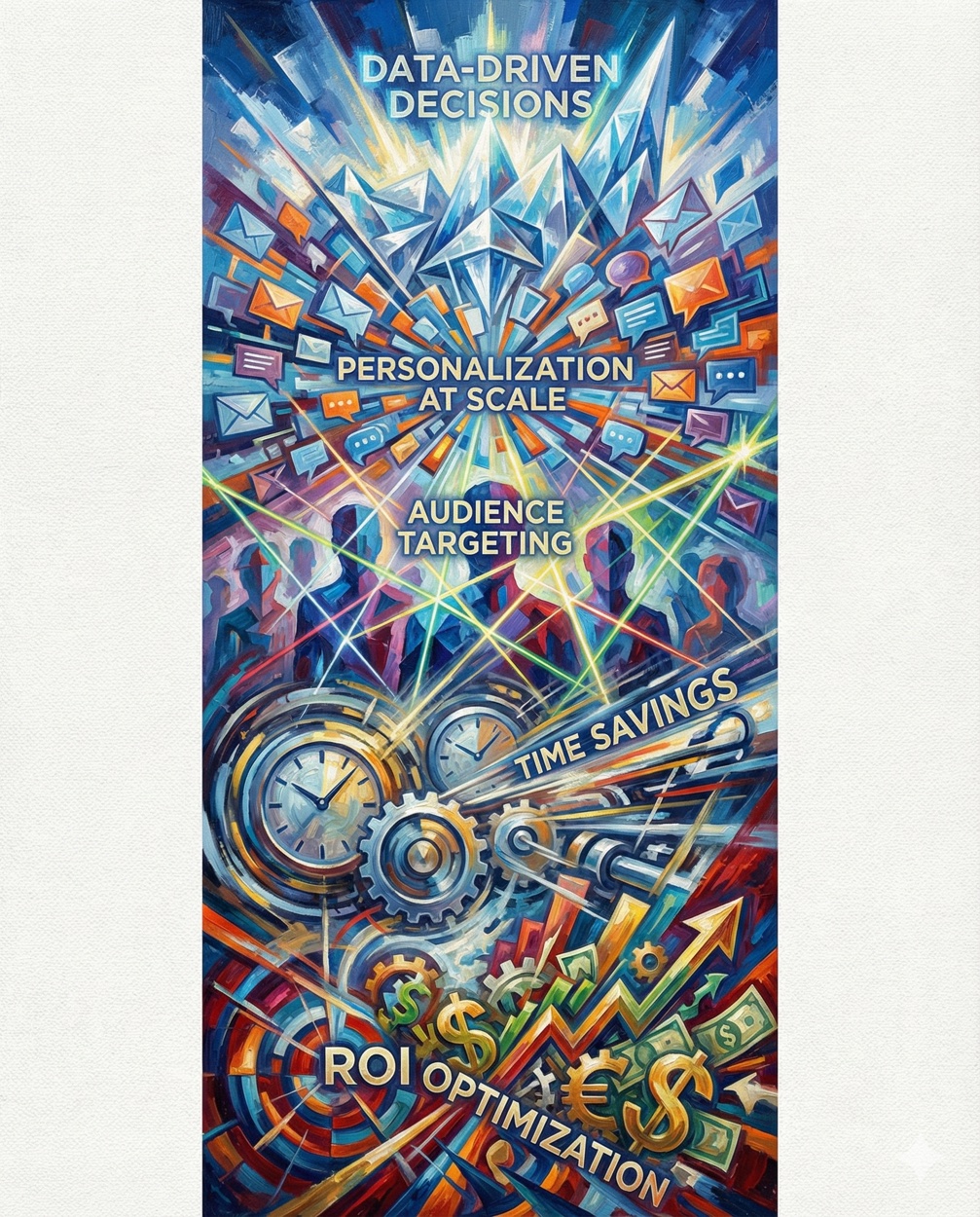
Improved ROI through optimization
The primary benefit of AI advertising is better return on advertising spend. Machine learning algorithms continuously optimize campaigns by analyzing conversion patterns, adjusting bids, and reallocating budget to high-performing segments. These optimizations happen faster and more precisely than manual management allows.
Time savings and efficiency
AI advertising saves time by automating routine tasks that previously required manual effort. Campaign setup, bid management, audience segmentation, and performance reporting can all be automated. This efficiency enables marketing teams to manage more campaigns or focus time on strategic initiatives.
Better audience targeting
AI-generated ads and targeting leverage data patterns that human analysts might miss. Machine learning models identify correlations between user behaviors and conversion likelihood, enabling more precise targeting. This precision reduces wasted impressions and increases relevance for potential customers.
"Our mission is simple: empower every enterprise to create high-quality, personalized content that aligns with its unique voice. Generative AI isn't just about speed. It's about authenticity at scale."
. Abhay Parasnis, CEO and Founder of Typeface
Personalization at scale
Perhaps most importantly, AI advertising enables personalization that would be impossible manually. Businesses can deliver tailored messages to different audience segments without creating thousands of individual ads. This capability supports effective content marketing strategy by ensuring the right message reaches the right audience.
Data-driven decision making
AI systems transform campaign data into actionable insights. Rather than reviewing spreadsheets, marketers receive recommendations and predictions that inform strategy. This shift from data analysis to insight application changes how teams approach advertising campaign management.
AI advertising trends for 2026
Several emerging trends will shape AI advertising throughout 2026. Understanding these developments helps marketers prepare for changes in the advertising landscape.
Agentic AI as the operating layer
According to eMarketer's CES 2026 coverage, agentic AI is becoming the operating layer for agencies. Rather than using AI for isolated tasks, marketing organizations are deploying AI agents that coordinate entire workflows. These agents handle campaign planning, creative production, media buying, and optimization as connected processes.
Salesforce Agentforce and HubSpot Breeze AI Agents represent early implementations of this trend. These platforms move beyond automation to true agency, where AI systems make decisions and take actions with minimal human oversight.
AI answer-engine optimization (AEO)
A significant shift in consumer behavior is driving a new discipline within AI advertising. Consumers increasingly get answers directly from AI systems instead of clicking links. This "zero-click world" requires new approaches to brand visibility.
"Google gives you ten blue links. You.com gives you answers, context, and even integrates your internal data. For professionals who need accuracy, this is the future of search."
. Richard Socher, CEO and Co-Founder of You.com
AI Answer-Engine Optimization focuses on ensuring brand presence within AI-generated responses. Companies like Peec AI, which raised 7M in seed funding in 2025, help brands measure and optimize visibility across AI platforms.
Privacy-safe contextual AI
With cookie deprecation now fully implemented, contextual AI advertising has matured significantly. Platforms like GumGum's Verity technology deliver ethical, accurate, and AI-supported targeting based on content context rather than user tracking. This approach aligns with both regulatory requirements and consumer privacy expectations.
Full-funnel AI-native platforms
Enterprise marketing stacks are transitioning from bolt-on AI tools to integrated AI-native platforms. These systems handle the complete journey from audience segmentation to creative production to media routing, all powered by unified AI models.
Human-AI collaboration
The competitive advantage in 2026 lies in brand-aligned, human-edited AI creative rather than raw AI output. Industry analyst consensus from McKinsey, Deloitte, and BCG confirms that the most effective approach combines AI capabilities with human oversight and creative direction.
Getting started with AI advertising
For businesses ready to implement AI advertising, a structured approach ensures successful adoption. Start with these practical steps to integrate artificial intelligence advertising into your marketing operations.
Begin with platform native features
The fastest path to AI advertising begins with features already available in major ad platforms. Google Performance Max, Meta Advantage+, and Microsoft Advertising Copilot require no additional tools or integrations. Enable these features on existing campaigns to experience AI optimization without major operational changes.
Test AI creative tools on small campaigns
Before scaling AI-generated creative across all campaigns, test with smaller budget campaigns. For a comprehensive comparison of leading AI creative platforms, see our guide to the best AI ad generators for 2026. This approach allows teams to evaluate quality, brand consistency, and performance without significant risk. Track metrics carefully to build confidence and identify areas for refinement.
Implement measurement and governance
Given that over 70% of marketers have encountered AI-related incidents, governance frameworks are essential. Establish review processes for AI-generated content, define quality standards, and create escalation procedures for problematic outputs. The FTC has issued guidance on AI in advertising that should inform compliance approaches.
Consider working with AI marketing specialists
Complex AI advertising implementations often benefit from specialist expertise. Matt Kundo and other digital marketing consultants can help businesses navigate the AI advertising landscape, select appropriate tools, and develop implementation strategies aligned with business objectives.
Key considerations before adopting
Before committing to AI advertising tools, evaluate:
- Integration requirements with existing marketing technology
- Data requirements and privacy compliance
- Team training and change management needs
- Budget for both tools and implementation
- Success metrics and measurement approaches
According to Deloitte's research on AI-powered marketing, organizations that approach AI adoption strategically see significantly better outcomes than those that adopt tools without clear implementation plans.
Conclusion
AI advertising has transformed from an emerging technology to an essential capability for competitive marketing in 2026. The combination of automated optimization, personalized creative generation, and predictive analytics enables businesses to achieve better results with greater efficiency.
The key to success lies in strategic implementation. Rather than adopting every available AI advertising tool, focus on platforms and capabilities that address specific business challenges. Combine AI power with human oversight to ensure brand consistency and avoid the pitfalls that have affected many early adopters.
For businesses ready to explore artificial intelligence advertising solutions, the starting point is clear: leverage the AI features already available in major ad platforms, then expand based on proven results. If you're considering professional help to implement these AI advertising strategies, our guide on how to hire a Google Ads expert covers essential qualifications and what to look for in 2026. The future of advertising is already here. The question is how quickly your business will embrace it.
Ready to transform your advertising with AI?
→ Schedule a free consultation to discuss your AI advertising strategy.
Sources
{
  "url": "https://mattkundodigitalmarketing.com/blog/ai-advertising-guide-2026/",
  "ai_url": "https://mattkundodigitalmarketing.com/ai/blog/ai-advertising-guide-2026/",
  "content_type": "pillar",
  "topic_cluster": "ai-marketing-automation",
  "categories": ["Paid Media"],
  "published": "Jan 12, 2026",
  "canonical": "https://mattkundodigitalmarketing.com/blog/ai-advertising-guide-2026/",
  "llms_txt": "https://mattkundodigitalmarketing.com/llms.txt"
}