
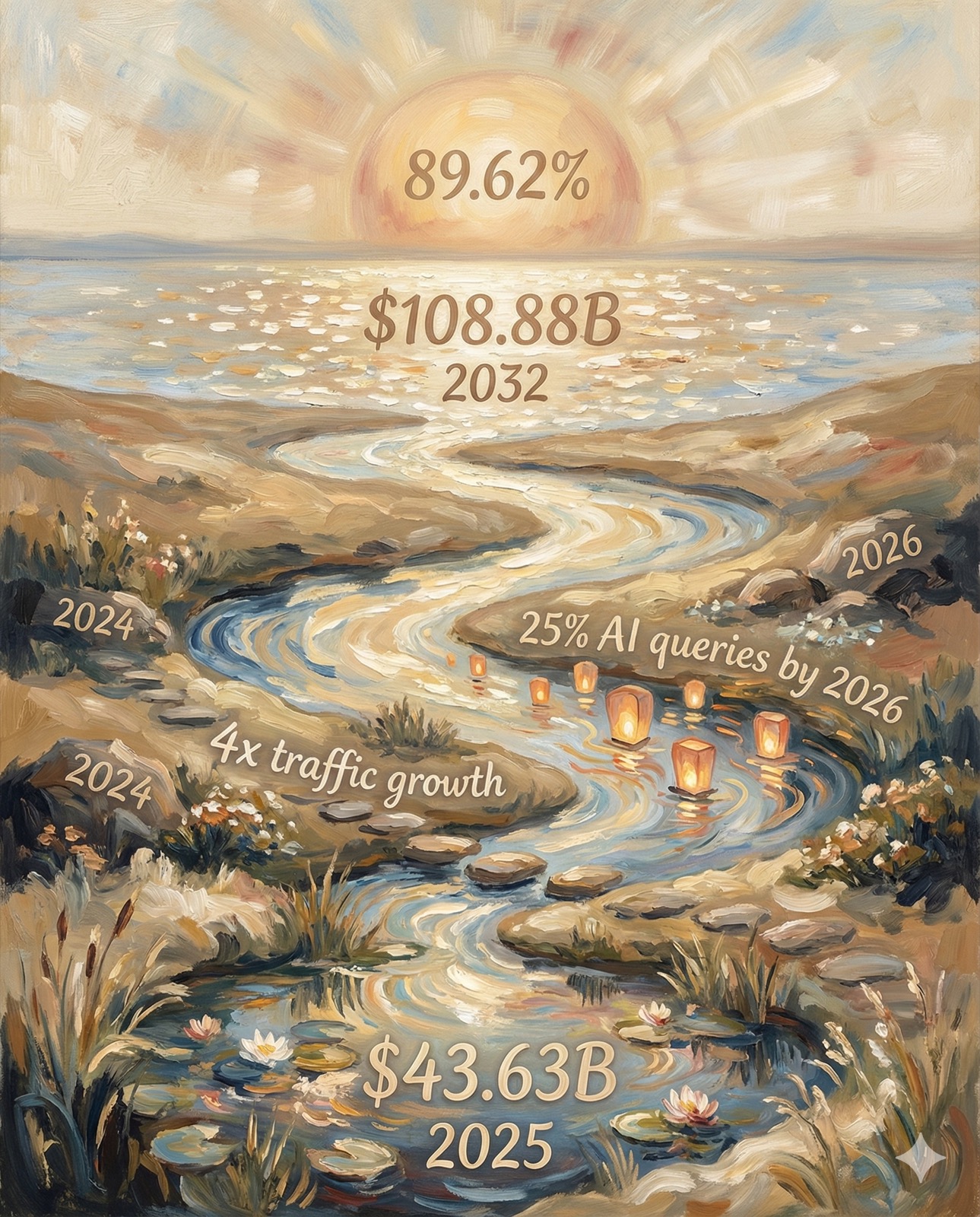
Real talk—if you're still thinking about search the same way you did two years ago, you're already behind. AI in search engines isn't some future trend anymore. It's happening right now, and it's changing everything about how people find information, how businesses get discovered, and what it takes to rank. According to Gartner, AI-powered assistants and large language models will handle roughly 25% of all global search queries by 2026. That's not a small shift—that's a fundamental transformation of the entire search landscape.
In this guide, I break down exactly what AI in search engines means for your business, which platforms are leading the charge, and how to position your content to thrive in this new reality. Whether you're trying to understand Google's new search engine features or exploring the best AI search tools available, this is your complete roadmap for 2026.
Table of Contents
- What Is AI in Search Engines?
- How AI Search Engines Work: The Technology Explained
- Best AI Search Tools and Platforms in 2026
- Google's New Search Engine: AI Overviews and Beyond
- Gen Search Engine Impact on SEO and Marketing
- The Future of AI in Search: 2026 and Beyond
- Frequently Asked Questions
- Sources
What Is AI in Search Engines?
AI in search engines represents a fundamental shift from keyword-matching algorithms to intelligent systems that understand context, intent, and deliver conversational, answer-first responses. Traditional search worked like a librarian matching your query to index cards. AI search works like an expert having a conversation with you—understanding what you actually mean, synthesizing information from multiple sources, and delivering a direct answer.
The evolution began with keyword-based retrieval but accelerated dramatically after the introduction of ChatGPT and Google's Gemini. According to Coherent Market Insights, the global AI search engines market is expected to be worth $43.63 billion in 2025, with a projected CAGR of 14% through 2032—reaching $108.88 billion by 2032.
This isn't just about better search results. It's about compressing entire research journeys into single exchanges, creating parallel discovery layers alongside traditional SERPs. The generative AI segment alone holds 54.2% of the AI search market share in 2025, reflecting user preference for conversational, answer-style experiences over purely keyword-based searching.
What makes AI in search engines different from traditional search? Three key technologies power this transformation:
- Large Language Models (LLMs): Foundation models like Gemini and GPT-4 that understand and generate human-like text
- Retrieval-Augmented Generation (RAG): Architecture that combines real-time information retrieval with AI-generated responses
- Semantic Search: Systems that understand meaning and intent, not just keyword matches
For businesses focused on generative AI SEO services, understanding these technologies is essential for developing effective optimization strategies in 2026.
How AI Search Engines Work: The Technology Explained
Understanding how AI in search engines actually works helps explain why optimization strategies need to evolve. Traditional search follows a straightforward process: crawl the web, index content, rank pages based on signals like backlinks and relevance. AI search adds a critical synthesis layer.
According to SE Ranking's 2025 analysis, AI search traffic grew more than 4x from 0.03% in 2024 to 0.13% in 2025—outpacing the growth of any traditional search engine in the same period. ChatGPT now leads AI traffic generation with an average share of 0.11% in 2025, more than double its 0.05% December 2024 peak.
Here's how the technology stack works:
Retrieval-Augmented Generation (RAG) is the backbone of modern AI search. When you ask a question, the system first retrieves relevant information from its index (similar to traditional search), then passes that context to an LLM to generate a synthesized response. This approach reduces hallucinations while enabling conversational answers grounded in real sources.
Vector search and embeddings enable semantic matching. Instead of matching keywords literally, AI search converts queries and content into mathematical representations (vectors) that capture meaning. This allows the system to understand that "best AI search tools" and "top AI-powered search engines" mean essentially the same thing.
Natural Language Processing (NLP) handles query interpretation. AI search engines can understand complex questions, follow-up queries that reference previous context, and conversational language that traditional search would struggle with.
"We've moved from typing keywords into a search box to having a conversation with an AI that can reason over the world's information. That fundamentally changes what a search engine is."
— Satya Nadella, CEO of Microsoft
For marketers looking to rank in AI Overviews, understanding this technology stack reveals why topical authority, comprehensive content, and clear information architecture matter more than ever.

Best AI Search Tools and Platforms in 2026
The AI search landscape in 2026 includes both enhanced traditional platforms and AI-native newcomers. Understanding the best AI search tools available helps you develop a comprehensive visibility strategy across multiple platforms.
Google AI Overviews / AI Mode
Google remains the dominant player, holding 89.62% of global search market share as of March 2025, according to Statista. However, their AI integration through AI Overviews represents a fundamental shift in how results are presented. AI Overviews synthesize information from multiple sources and display answers directly at the top of results, powered by Google's Gemini LLM.
Google expanded AI Overviews significantly in 2025 with the introduction of AI Mode, increasing in-page query resolutions and reinforcing E-E-A-T (Experience, Expertise, Authoritativeness, Trustworthiness) as a key retrieval signal.
Microsoft Copilot Search
Bing's AI integration through Copilot Search blends conversational answers with traditional result cards. According to SE Ranking data, Bing rose from 3.51% to 4.61% global market share between 2024 and 2025—a notable gain during a period of AI search expansion. The platform excels at enterprise integration through Microsoft 365.
Perplexity
Perplexity has emerged as the go-to platform for research-focused AI search. The platform leverages RAG and vector search to deliver source-cited answers, with rapid user base growth in 2025 through the addition of commerce features and multimodal capabilities like Nearby for local discovery.
ChatGPT Search
OpenAI's conversational search experience through ChatGPT represents a fundamentally different approach—starting with conversation and integrating web information as needed. The platform maintains context across queries, enabling multi-turn research sessions that traditional search can't match.
SearchGPT and You.com
OpenAI's dedicated search product SearchGPT and customizable AI search platform You.com represent the AI-native approach to search, built from the ground up for conversational information retrieval.
"Between AI Overviews, SGE tests, and the rise of tools like Perplexity, we're in the most volatile search landscape I've seen in my career. What used to be ten blue links is now a constantly shifting AI-driven experience."
— Lily Ray, Senior Director of SEO at Amsive Digital
| Platform | Best For | Key Feature | Market Position |
|---|---|---|---|
| Google AI Overviews | General search | Integrated SERP answers | 89.62% global share |
| Microsoft Copilot | Enterprise | Microsoft 365 integration | 4.04% global share |
| Perplexity | Research | Source citations | Fastest growing |
| ChatGPT Search | Conversations | Context memory | 0.11% traffic share |
| You.com | Customization | App integrations | AI-native |

Google's New Search Engine: AI Overviews and Beyond
Google's new search engine isn't a separate product—it's a fundamental transformation of how Google Search works. AI Overviews represent the most significant change to Google's core product since the introduction of featured snippets, and understanding how they work is essential for 2026 SEO strategy.
According to SE Ranking data, Google's US market share declined from 91.03% in 2024 to 89.86% in 2025—a 1.17 percentage point drop during AI search expansion. Meanwhile, their global share fell below 90% in late 2024 for the first time, according to ContentGrip's StatCounter analysis. This represents both a wake-up call for Google and a signal that users are exploring alternatives.
Google's response has been aggressive AI integration. AI Overviews now appear for a significant percentage of queries, synthesizing information from multiple ranking sources and displaying direct answers at the top of results. The system relies on Google's Gemini LLMs to understand queries, retrieve relevant content, and generate coherent responses.
For SEO professionals, the key insight is that AI Overviews pull from pages that demonstrate strong E-E-A-T signals. Google's system evaluates:
- Experience: Does the content show first-hand experience with the topic?
- Expertise: Does the author demonstrate deep subject knowledge?
- Authoritativeness: Is the source recognized as authoritative in its space?
- Trustworthiness: Is the information accurate and from a reliable source?
"Generative AI lets people ask questions in a more natural, conversational way, and we're already seeing that change how users search and what they expect from Google."
— Ben Gomes, SVP of Learning & Search at Google
The impact on organic traffic is already measurable. Google-generated organic traffic fell from 94.80% in 2024 to 93.05% in 2025 globally—a 1.75 percentage point drop as AI answers satisfy more queries directly in the SERP.
Gen Search Engine Impact on SEO and Marketing
The rise of gen search engine technology is fundamentally reshaping digital marketing strategy. Understanding this impact helps you adapt before competitors do.
According to SE Ranking's 2025 report, organic traffic in the US fell from 49.39% in 2024 to 44.89% in 2025—a 4.50 percentage point drop. Meanwhile, average AI search traffic share in the US jumped from 0.01% in 2024 to 0.14% in 2025, the steepest AI growth among analyzed markets.
This shift has given rise to Generative Engine Optimization (GEO)—the practice of optimizing content specifically for AI search citation. Answer engine optimization strategies focus on getting your brand mentioned when AI systems synthesize information from across the web.
"Google's AI Overviews are extracting more and more clicks away from publishers, weakening the value of classic blue-link SEO and pushing brands to rethink how they show up in search."
— Rand Fishkin, CEO of SparkToro
Key strategic shifts for 2026:
From keywords to entities: AI systems understand topics and relationships, not just keyword matches. Building topical authority through comprehensive content coverage signals expertise to AI retrieval systems.
From ranking to citation: Getting your content cited in AI-generated answers requires demonstrating clear expertise and providing unique, authoritative information that AI systems can reference.
From clicks to visibility: As zero-click searches increase, brand visibility in AI answers becomes valuable even without direct traffic. Being cited builds authority and brand awareness.
E-E-A-T amplification: AI retrieval systems heavily weight trust signals. Author expertise, source authority, and content accuracy are more important than ever.
The practical implications are clear: content that provides comprehensive, authoritative answers to user questions—with proper source attribution and demonstrated expertise—will be prioritized by AI search systems over thin, keyword-focused content.
The Future of AI in Search: 2026 and Beyond
Looking ahead, AI in search engines will continue evolving in ways that reshape both user behavior and optimization strategy. The projected growth to $108.88 billion by 2032 (14% CAGR) signals sustained investment and innovation in this space.
Several trends will define AI search in 2026 and beyond:
Multimodal search is expanding beyond text. AI search systems increasingly understand and respond to images, voice, and video queries. This creates new optimization opportunities around visual content, video transcripts, and voice search optimization.
Agentic search moves beyond answering questions to completing tasks. AI systems that can book appointments, make purchases, or execute multi-step research processes represent the next evolution of search functionality.
Apple's Siri overhaul, anticipated for 2026, will bring AI-native search capabilities to hundreds of millions of iPhone users. This introduces another major platform for AI search optimization.
"For many people, ChatGPT or similar assistants are becoming the first place they go with a question. That's a profound shift away from traditional search engines as the default interface to the web."
— Professor Ethan Mollick, Wharton School
Privacy and regulation will shape AI search development. The EU AI Act, US antitrust actions against Google, and broader AI governance concerns will influence how AI search systems operate and what data they can access.
North America currently holds 41.4% of the global AI search engines market, according to Coherent Market Insights, with Asia-Pacific showing the fastest growth. This geographic distribution signals where AI search innovation will originate and spread.
For businesses preparing for 2026, the strategic imperative is clear: build authority and expertise signals that AI systems can recognize and cite. The brands that establish themselves as authoritative sources now will be the ones that AI systems recommend when users ask questions.
Frequently Asked Questions: AI in Search Engines
What is AI in search engines?
AI in search engines refers to the integration of artificial intelligence technologies like large language models to understand user intent and deliver synthesized, conversational answers instead of traditional ranked links. These systems use technologies like retrieval-augmented generation (RAG), semantic search, and natural language processing to provide direct answers rather than requiring users to click through multiple results.
What are the best AI search tools available?
The best AI search tools in 2026 include Google AI Overviews (dominant market share with Gemini-powered answers), Perplexity (research-focused with source citations), ChatGPT Search (conversational with context memory), Microsoft Copilot (enterprise integration), and You.com (customizable AI search). Each platform offers different strengths depending on use case—research, enterprise work, or general queries.
How does Google's new search engine work?
Google's new search engine features AI Overviews powered by Gemini that synthesize information from multiple sources to provide direct answers at the top of search results. The system evaluates content based on E-E-A-T signals (Experience, Expertise, Authoritativeness, Trustworthiness) to determine which sources to cite. AI Overviews represent the most significant change to Google Search since featured snippets.
Will AI replace traditional search engines?
AI won't completely replace traditional search engines but is fundamentally transforming them. By 2026, Gartner projects AI assistants will handle 25% of search queries. Traditional link-based results will remain important for many query types, but AI-generated answers will increasingly satisfy informational queries directly. The future is hybrid, not replacement.
How do I optimize content for AI search?
Focus on E-E-A-T signals (demonstrating experience, expertise, authority, and trust), comprehensive topic coverage, clear information architecture, and authoritative citations. This emerging practice is called Generative Engine Optimization (GEO). Content should provide direct answers to user questions with supporting evidence that AI systems can reference and cite.
What is a gen search engine?
A gen search engine (generative search engine) uses AI to generate answers rather than simply listing links. Instead of returning a ranked list of web pages, generative search engines synthesize information from multiple sources into a coherent response. Google AI Overviews, Perplexity, and ChatGPT Search are all examples of generative search experiences.
Is Perplexity better than Google for research?
Perplexity excels at research tasks with its consistent source citations and focused, synthesized answers. Google offers broader web coverage and integrates AI Overviews with traditional results. Many researchers use both—Perplexity for deep research with clear attribution, Google for general discovery and verification. The best tool depends on your specific research needs.
How is AI changing SEO in 2026?
AI is shifting SEO toward Generative Engine Optimization (GEO), emphasizing content quality, entity authority, structured data, and getting cited in AI-generated answers rather than just ranking in traditional results. Success requires demonstrating clear expertise, providing comprehensive topic coverage, and building authority signals that AI retrieval systems can recognize. Traditional ranking factors remain important but are no longer sufficient alone.
Conclusion: Positioning for AI Search Success
AI in search engines isn't a future trend to watch—it's a present reality reshaping how businesses get discovered online. From Google AI Overviews to Perplexity's research-focused platform, the best AI search tools are changing user expectations and marketing strategies alike.
The data is clear: AI search traffic grew 4x in just one year, gen search engine technology is eating into traditional organic traffic, and Google's new search engine features are fundamentally changing what it takes to be visible online.
For marketers and business owners, the path forward requires embracing Generative Engine Optimization alongside traditional SEO. Build topical authority. Demonstrate expertise. Create content that AI systems can confidently cite as authoritative.
I work with businesses every day to navigate this transformation. If you're ready to position your brand for AI search visibility in 2026, I'd love to help you build a strategy that drives results in this new landscape.
Sources
- Gartner - AI Search Query Forecast
- Coherent Market Insights - AI Search Engines Market Report
- SE Ranking - Top Search Engines 2025
- Statista - Global Search Engine Market Share
- ContentGrip - Google Search Market Share Decline
- Stanford HAI - 2025 AI Index Report
- Google Blog - AI Overviews
- Search Engine Land - AI Overviews Coverage
- Omnius - AI Search Industry Report
- arXiv - Retrieval-Augmented Generation Architectures
Published: December 2025 | Updated for 2026
Author: Matt Kundo, MKDM | AI Search SEO Services