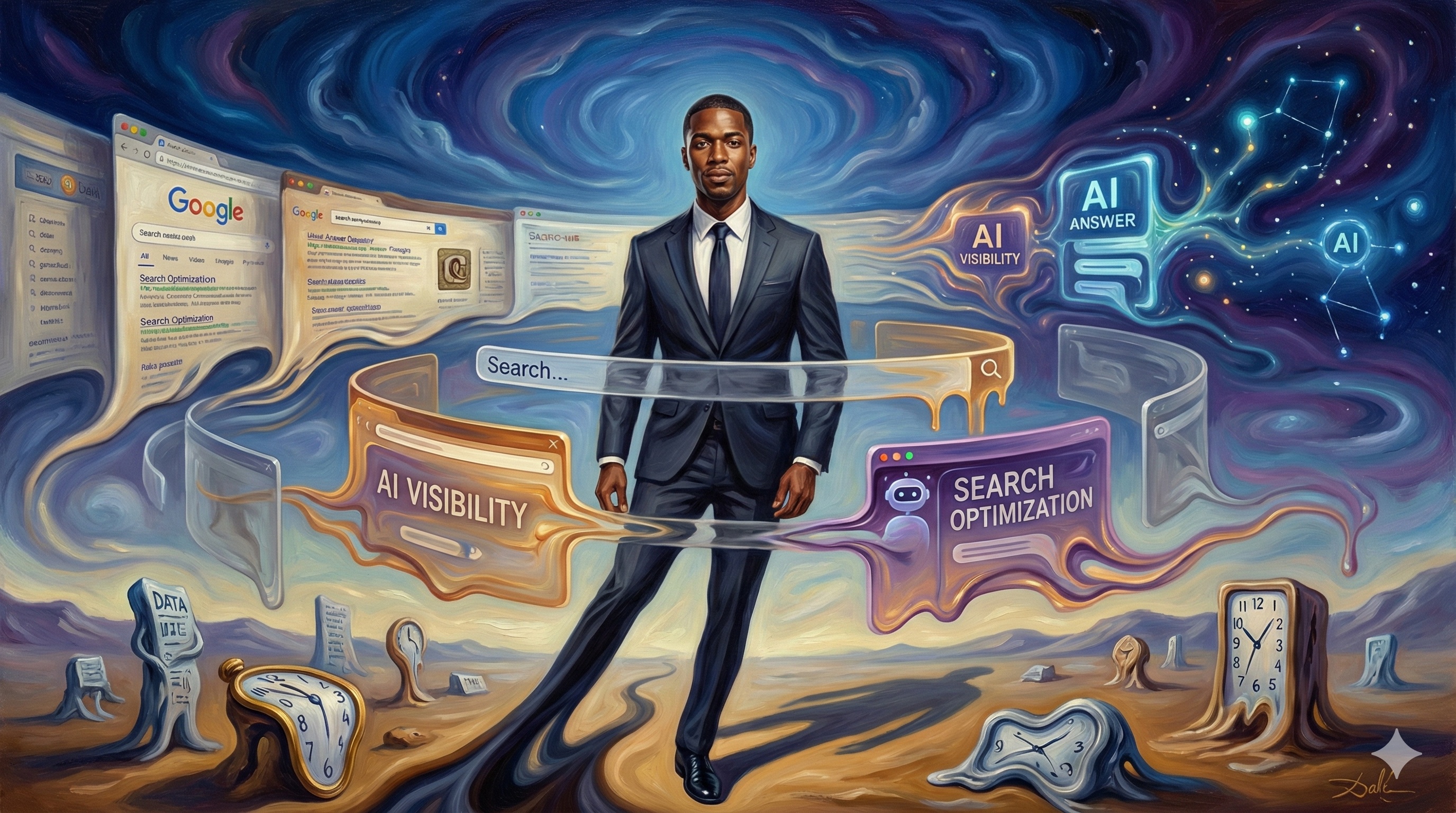
AI visibility is the measure of how frequently and effectively your brand's content appears within AI-powered search results and LLM-generated answers. The most effective strategies for AI visibility enhancement include entity optimization, structured data implementation, creating citation-worthy content, multi-platform monitoring, and GEO-focused content optimization.
I've watched dozens of businesses pour resources into traditional SEO while completely ignoring how ChatGPT, Perplexity, and Google's AI Overviews are reshaping search. The frustrating part? Most of them don't even know they're invisible in these AI-powered experiences. The game has fundamentally changed, and the tools to play it are finally catching up.
Let me break down what's actually working in AI visibility optimization—and which products can help you get there.
Why Traditional SEO Isn't Enough Anymore
AI visibility is the measure of how frequently and effectively your brand's content appears within AI-powered search results and LLM-generated answers. If you're not tracking this metric, you're flying blind in the new search landscape.
Here's the reality: AI search engines—platforms like ChatGPT, Perplexity, Google AI Overviews, and Microsoft Copilot—answer queries fundamentally differently than traditional search. They don't just rank pages; they synthesize information, cite sources selectively, and provide direct answers that often eliminate the need for users to click through.
According to research from ALM Corp, 52% of sources cited in Google AI Overviews already rank in the top 10 traditional results—but that means 48% come from outside the top 10. Your traditional rankings don't guarantee AI visibility.
The shift is happening fast. SEOmator reports that 86.07% of SEO professionals have already integrated AI into their strategy, and the AI-powered SEO sector has reached $67 billion in 2025, driven by a 22% compound annual growth rate since 2020.
For a comprehensive overview of the platforms that power this transformation, see my complete guide to content optimization tools.
How AI Visibility Products Track and Optimize Your Presence
Understanding AI visibility products requires knowing what they actually measure and how they differ from traditional SEO tools.
Citation and Mention Tracking
Citation and mention tracking is an analytics function that measures where and how often your brand or URL is referenced in AI-generated answers and summaries. Unlike traditional rank tracking, this monitoring happens across multiple AI platforms simultaneously.

Leading platforms in this space include:
- Profound — An AI search visibility platform focused on generative engine optimization (GEO), monitoring brand presence across ChatGPT, Claude, Perplexity, and Google AI Overviews with competitive analytics
- Otterly.AI — Tracks brand mentions and citations across AI engines and ties them to specific keyword prompts
- Peec AI — Measures AI visibility including mentions, position, and sentiment while identifying high-value prompts to grow traffic from LLMs
AI-Powered SERP Analysis
AI-powered SERP analysis uses machine learning and LLMs to analyze search results pages at scale, extracting patterns, entities, and optimization opportunities that inform your AI visibility strategy.
The Semrush AI Toolkit extends traditional SEO capabilities with AI-prioritized site audits and visibility insights across AI search engines. Meanwhile, BrightEdge provides enterprise-level AI-driven SEO recommendations with real-time brand visibility tracking.
"The more likely you are to be sourced or included in a response to a query from AI, the more likely you are to become top of mind and have your website visited or brand engaged with."
— Ross Simmonds, CEO of Foundation Marketing
To understand how these tools fit into the broader optimization landscape, explore the concepts behind Generative Engine Optimization (GEO).
5 Most Effective Strategies for AI Visibility Enhancement
Based on current research and tool capabilities, these are the strategies delivering measurable results.
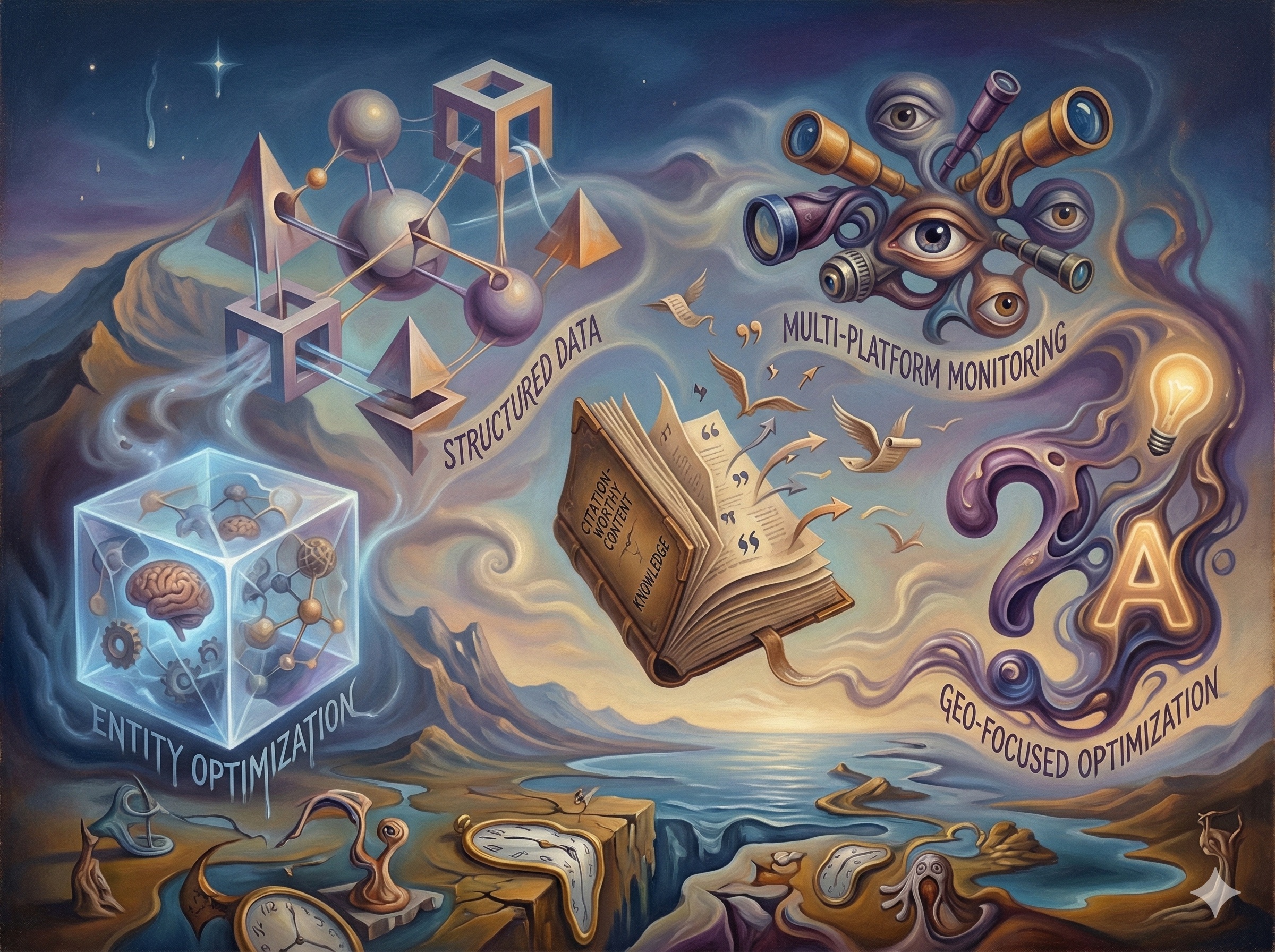
Strategy 1: Entity Optimization
Entity optimization is the SEO practice of structuring and enriching content around entities—people, organizations, products, and concepts—that search and AI systems recognize to improve relevance and visibility.
AI systems process content through entity relationships, not just keywords. When you clearly define entities on first mention and build logical connections throughout your content, you're speaking the language AI understands.
Key implementation steps:
- Define all entities on first mention
- Create clear entity relationships within content
- Use structured data to reinforce entity connections
- Maintain consistent entity naming across your site
Strategy 2: Structured Data Implementation
Schema markup isn't just for traditional rich snippets anymore.
"Generative AI uses structured data to better understand and present your content, so investing in schema markup is also investing in your visibility in AI-powered search experiences."
— Martha van Berkel, Co-founder and CEO of Schema App
Structured data helps AI systems confidently extract, attribute, and feature your content. Implement comprehensive schema for:
- Organization information
- Article content
- Author expertise (E-E-A-T signals)
- Product and service details
- FAQ content
Strategy 3: Comprehensive, Citation-Worthy Content
AI systems cite sources that provide clear, authoritative answers. According to SEOmator, companies leveraging AI for SEO-driven content strategies have seen up to a 45% increase in organic traffic and 38% increase in conversion rates for e-commerce.
To become citation-worthy:
- Include original statistics and research
- Add expert quotes with full attribution
- Provide specific, factual data AI systems can reference
- Structure content with clear, direct answers first
Research shows that 70% of businesses report higher ROI after integrating AI into their SEO workflows, according to ALM Corp's 2025 guide.
Strategy 4: Multi-Platform AI Visibility Monitoring
You can't improve what you don't measure. Tracking your presence across ChatGPT, Perplexity, Google AI Overviews, and Claude requires specialized tools.
OmniSEO (WebFX) monitors AI search performance tied to ROI analytics. Conductor tracks brand authority and citations across AI engines with integrated content workflows. xFunnel provides AI visibility tracking with response and intent analysis.
According to SEOmator, AI tools are capable of improving SEO rankings by 49.2%, with nearly half of businesses using AI reporting enhanced rankings after Google algorithm updates.
Strategy 5: GEO-Focused Content Optimization
Generative Engine Optimization (GEO) is the practice of optimizing content so that generative AI answer engines cite and recommend your brand more often and more prominently.
GEO requires:
- Answer-first content structure
- Natural language processing alignment
- Clear, concise explanations suitable for AI summarization
- Content that reads well when extracted as quotes
Recent studies show that companies leveraging AI in their SEO strategies improved rankings by 30% within 6 months, according to SEOmator research.
How to Choose the Right AI Visibility Product for Your Business
Selecting the right tool depends on your specific needs, team size, and existing tech stack.
Evaluation Criteria
When assessing AI visibility products, consider:
- Platforms tracked — Does it cover ChatGPT, Perplexity, Google AI Overviews, Claude, and Copilot?
- Reporting depth — Can you see specific prompts triggering your mentions?
- Integration capabilities — Does it connect with your existing SEO and analytics tools?
- Competitive benchmarking — Can you compare your AI visibility to competitors?
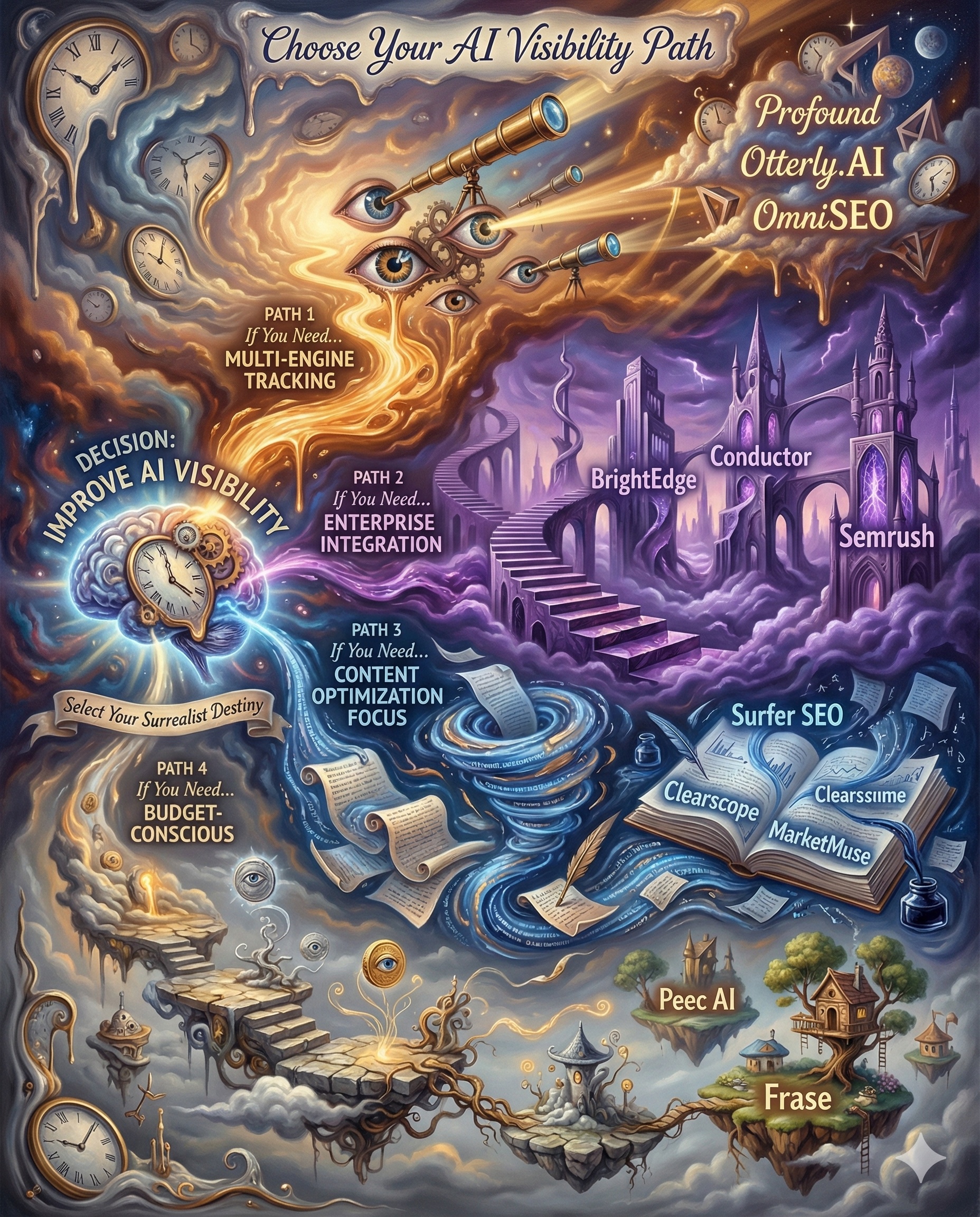
Decision Framework
| If You Need... | Consider... |
|---|---|
| Multi-engine tracking | Profound, Otterly.AI, OmniSEO |
| Enterprise integration | BrightEdge, Conductor, Semrush AI Toolkit |
| Content optimization focus | Surfer SEO, Clearscope, MarketMuse |
| Budget-conscious option | Peec AI, Frase |
The market is growing rapidly. According to SEO.com, the global AI SEO software tool market is projected to grow from $1.99 billion in 2024 to $4.97 billion by 2033.
Among companies with over 200 employees, 83% report improved performance since adopting AI SEO tools, based on ALM Corp research.
What AI Visibility Means for Your Marketing Strategy
AI visibility isn't a nice-to-have—it's becoming essential for brand discovery.
"Global brands need to think about AI search visibility the same way they think about international SEO: localized, technically sound, and consistently monitored across markets."
— Aleyda Solís, International SEO Consultant and Founder of Orainti
Why Marketers Should Care
The shift to AI-powered search creates both challenges and opportunities for marketers who act decisively.
- Brand discovery is shifting — More users are getting answers directly from AI without clicking through to websites. This means your traditional traffic metrics may not capture your full brand reach.
- Early movers gain advantage — Brands establishing AI visibility now are building competitive moats that will be harder for competitors to overcome as these platforms mature.
- Integration is possible — AI visibility tools can work alongside existing SEO and content workflows without requiring a complete overhaul of your marketing operations.
- ROI is measurable — Unlike traditional brand awareness, AI visibility can be tracked with specific metrics including citation frequency, mention sentiment, and prompt coverage.
The financial opportunity is significant. According to SEO.com research, businesses can expect revenue increases of 3%-15% and sales ROI uplift of 10%-20% when they invest strategically in AI-driven SEO optimization.
The numbers support this urgency. According to Moz research cited by SEOmator, 19% of Google search results now include AI-generated content, and 13% of top-rated content on Google is AI-generated—up from just 2.3% before GPT-2.
Ready to Improve Your AI Visibility?
AI visibility optimization isn't about replacing your existing SEO strategy—it's about extending it into the new search reality.
Here's what to do next:
- Audit your current AI visibility using tools like Profound, Otterly.AI, or Semrush AI Toolkit
- Implement entity optimization in your highest-value content
- Add structured data to help AI systems understand your content
- Monitor and iterate based on which platforms are citing your brand
At Matt Kundo Digital Marketing, I help businesses navigate the rapidly evolving AI search landscape with strategies grounded in data and real results. If you're tired of being invisible in AI search and ready to take action, let's talk.
Frequently Asked Questions About AI Visibility
What is AI visibility?
AI visibility measures how frequently and effectively your brand appears in AI-powered search results and LLM-generated answers across platforms like ChatGPT, Google AI Overviews, and Perplexity. It's the new metric for brand discoverability in the age of generative search.
How do AI visibility tools differ from traditional SEO tools?
Traditional SEO tools track rankings and traffic from organic search. AI visibility tools specifically monitor how AI systems cite, reference, and recommend your brand in their generated responses—tracking a completely different set of signals and surfaces.
How long does it take to improve AI visibility?
Most businesses see measurable improvements in AI visibility within 3-6 months of implementing GEO strategies, though results vary based on content volume, optimization intensity, and competitive landscape. Early wins often come from optimizing existing high-performing content for AI citation, while broader improvements develop as you build entity authority across your content portfolio.
What's the difference between GEO and traditional SEO?
Generative Engine Optimization (GEO) focuses specifically on how AI systems select, summarize, and cite content in their responses. Traditional SEO optimizes for ranking factors in blue-link search results. While they share foundations—quality content, authority signals, user intent—GEO emphasizes answer-first structure, entity clarity, and citation-worthiness that makes content suitable for AI synthesis.