
According to Adobe, generative AI traffic to US retail sites increased 4,700% year-over-year by July 2025. That's not a typo. And with OpenAI launching Shopping Research to 400 million weekly ChatGPT users on November 24, 2025, the shift from search bars to AI shopping assistants just went mainstream.
This isn't another feature announcement to file away. For ecommerce brands and marketers, ChatGPT shopping represents a fundamental change in how consumers discover and choose products. The question isn't whether AI shopping assistants will impact your business—it's whether you'll be ready when they do.
Here's what the ChatGPT shopping rollout means and exactly how to optimize your ecommerce presence for AI-powered product discovery.
What ChatGPT Shopping Actually Does
The Shopping Research Feature
OpenAI's Shopping Research transforms ChatGPT into a conversational shopping assistant. Users describe what they need, and ChatGPT asks clarifying questions about budget, preferences, and specific criteria before searching the web and delivering personalized product recommendations.
The feature runs on a specialized GPT-5 mini model that achieves 52% product accuracy on multi-constraint queries—a 40% improvement over standard ChatGPT Search. It excels in detail-heavy categories like electronics, beauty, home and garden, kitchen appliances, and sports equipment.
What makes this different from Google Shopping? ChatGPT remembers your preferences. If memory is enabled, it pulls context from past conversations to personalize recommendations. You can provide real-time feedback like "not interested" or "more like this" to refine results as it researches on your behalf.
Instant Checkout Changes Everything
Shopping Research directs users to merchant websites to complete purchases. But OpenAI also launched Instant Checkout, which enables direct purchasing within ChatGPT for participating merchants.
Instant Checkout runs on the Agentic Commerce Protocol, co-developed with Stripe. Current merchant partners include Target, Walmart, Etsy, and Shopify merchants like Glossier, SKIMS, Spanx, and Vuori.
The Numbers That Should Wake Up Every Ecommerce Brand
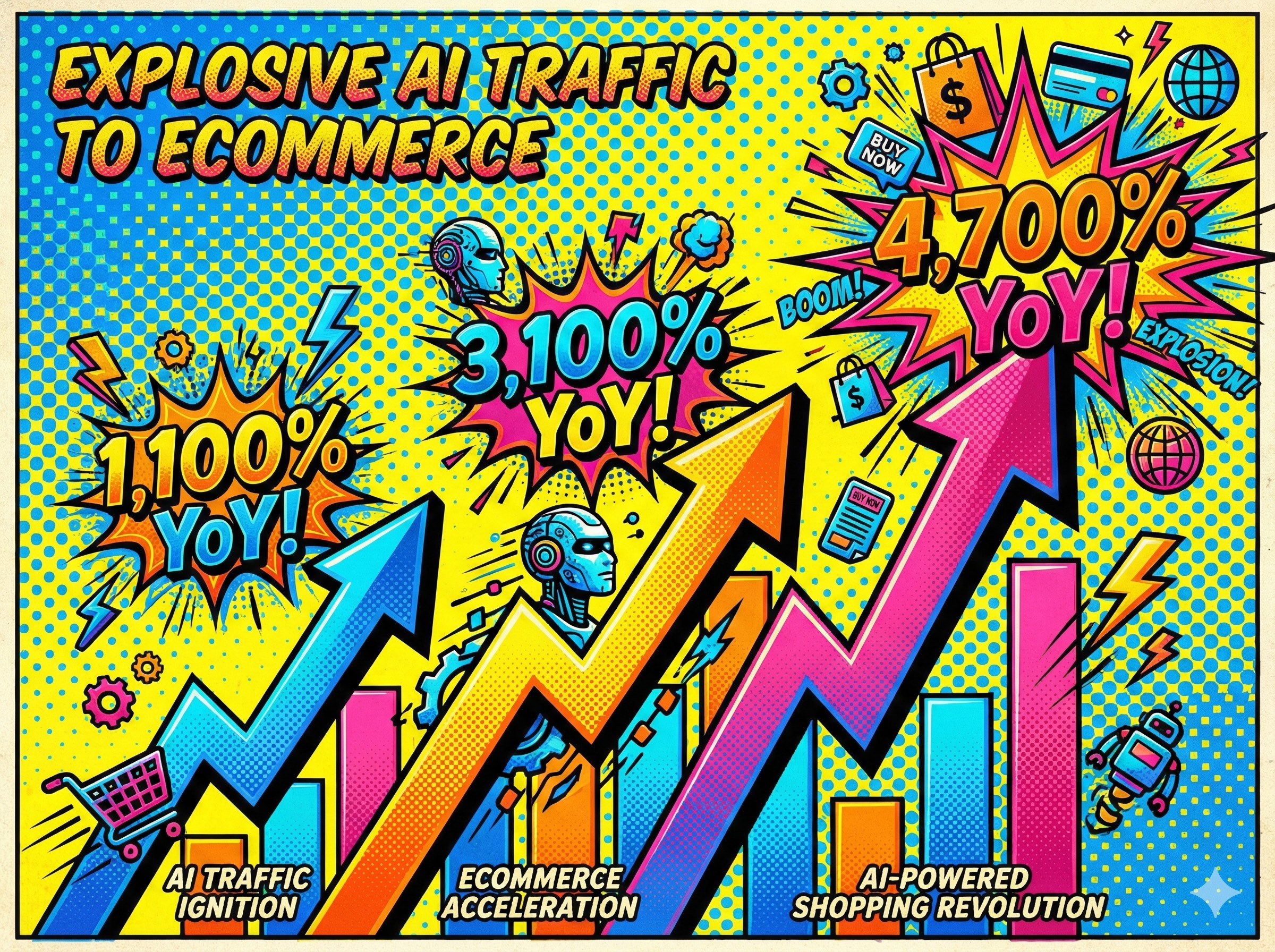
AI Traffic Explosion
- January 2025: 1,100% YoY increase in AI traffic to retail sites
- April 2025: 3,100% YoY increase
- July 2025: 4,700% YoY increase
Consumer Adoption
- 38% of consumers already used AI for shopping in 2025
- 52% plan to use AI shopping assistants this year
- 71% of consumers support AI integration in retail
- 74% prefer chatbots over human customer service
Conversion Impact
- Shoppers using AI chat convert at 12.3% vs 3.1% without—a 4X increase
- Returning shoppers who use AI chat spend 25% more
- AI-driven revenue-per-visit increased 84% from January to July 2025
How Brands Get Recommended by AI Shopping Assistants
How the System Works
AI shopping assistants follow a consistent process:
- Parse language using NLP – Natural language processing identifies what you're actually looking for
- Identify product attributes – Budget, features, use case, preferences
- Apply ML filtering – Machine learning algorithms match products based on user criteria and past data
- Synthesize recommendations – Pull from trusted sources and present with reasoning
The GEO Playbook for AI Shopping
Generative Engine Optimization (GEO) is the practice of optimizing content to appear in AI-generated responses. For ecommerce, GEO requires specific tactics:
Product Feed Optimization
Your product feed is the foundation. AI systems need clear attributes, comprehensive specifications, and structured data they can parse accurately.
Schema Markup
Implement Product, Review, FAQ, and Offer schemas. Structured data helps AI systems understand exactly what you sell, at what price, with what specifications, and how customers rate it.
Answer-First Content
Create product pages and buying guides that lead with direct answers to shopping questions. AI shopping assistants look for content that directly addresses user queries.
What's Different from Traditional SEO
| Traditional SEO | GEO for AI Shopping |
|---|---|
| Keywords in titles | Natural language query matching |
| Link building | Authority citations across sources |
| Featured snippets | Direct AI recommendations |
| Search rankings | Inclusion in AI responses |
| Click-through optimization | Conversion in-chat |
7-Point Optimization Checklist for AI Shopping Visibility
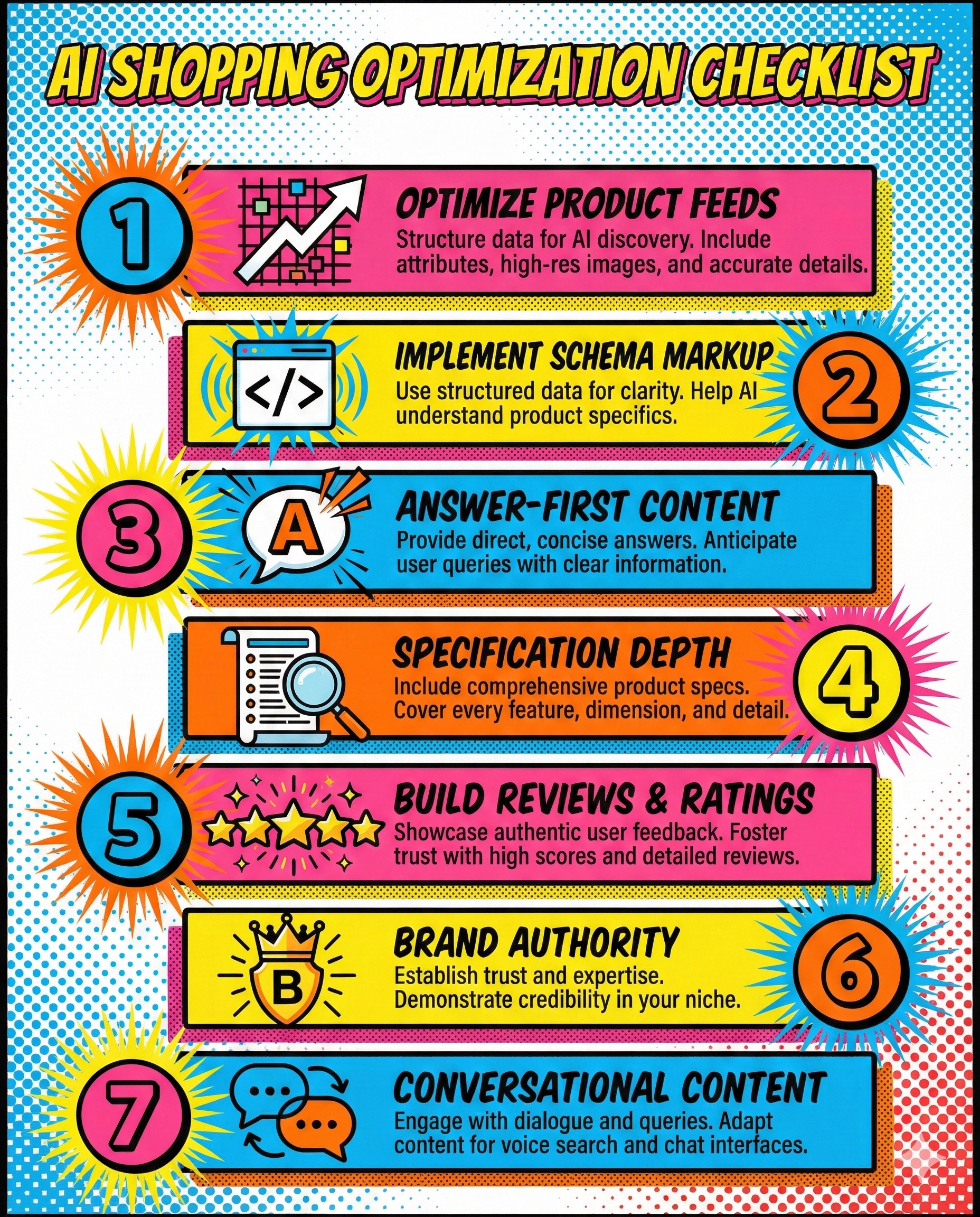
- Optimize Product Feeds – Ensure every product has clear attributes, comprehensive specs, and consistent data formatting
- Implement Schema Markup – Deploy Product, Review, FAQ, and Offer schemas on all product pages
- Create Answer-First Content – Build buying guides and product pages that lead with direct answers
- Maximize Specification Depth – Provide comprehensive technical specifications
- Build Review & Rating Signals – Encourage reviews on your site and third-party platforms
- Strengthen Brand Authority – Get mentioned on trusted sites AI systems pull from
- Develop Conversational Content – Create FAQ pages that match how people ask AI assistants questions
Ready to Optimize for the AI Shopping Era?
ChatGPT's shopping rollout isn't just another platform update. It's the beginning of a fundamental shift in how consumers discover and choose products. The 4,700% traffic growth isn't slowing down, and neither is consumer adoption.
Ready to optimize for AI shopping assistants? At Matt Kundo Digital Marketing, I help brands navigate exactly these kinds of shifts. My approach focuses on what actually drives measurable results: structured data optimization, authority building, and content strategies that work for both traditional search and AI discovery. Let's talk about your strategy.
Frequently Asked Questions
What is ChatGPT Shopping Research?
ChatGPT Shopping Research is OpenAI's feature enabling conversational product discovery. Users describe what they need, ChatGPT asks clarifying questions, then delivers personalized product recommendations with cited sources. It launched November 24, 2025.
What is GEO (Generative Engine Optimization)?
GEO refers to optimization strategies designed to help content and products appear in AI-generated responses and recommendations. For ecommerce, this includes schema markup, product feed optimization, and authority building.
What's the ROI of AI shopping optimization?
Data shows shoppers using AI chat convert at 4X the rate of those who don't (12.3% vs 3.1%), and returning AI chat users spend 25% more. AI-driven revenue-per-visit increased 84% in the first half of 2025.