
I've been tracking search behavior for over a decade, and nothing compares to the shift happening right now. The way people find information is changing faster than most marketers realize. If you're still optimizing the same way you did two years ago, you're already falling behind.
The future of search isn't some distant concept. It's here, and it's fundamentally different from what came before. AI Overviews now appear in over 30% of Google desktop searches, reaching 1.5 billion monthly users worldwide. Meanwhile, ChatGPT processes roughly 1 billion queries daily. This isn't a gradual evolution. It's a transformation that demands immediate attention.
Understanding the future of search marketing requires grasping how ai search seo works in this new landscape. The rules have changed, and the businesses that adapt quickly will capture opportunities their competitors miss entirely.
The Current State of Search in 2026
Google still dominates traditional search with 89.6% global market share. But that statistic tells an incomplete story. According to Search Engine Land, AI tool adoption has surged from 8% in 2023 to 38% overall, with 21% of US users now classified as "heavy" AI search users who query these tools ten or more times monthly.
The alternative search landscape has exploded. ChatGPT commands 60.6% of the AI search market with its 5.4 billion monthly visits, making OpenAI's platform the world's fifth most visited website. Perplexity processes approximately 30 million daily queries with 6.2% market share. Even Claude has carved out 3.2% of AI search volume.
These aren't niche tools anymore. According to Omnius, impressions on traditional search are up 49% year-over-year, but click-through rates have dropped 30% as users increasingly find answers directly in AI-generated summaries. The future of search engine marketing must account for this fundamental behavior shift.
Five Forces Shaping the Future of Search
AI Overviews and Zero-Click Search
When Google's AI Overviews trigger on a query, click-through rates for the top organic position drop by 34.5%, according to Ahrefs research. This represents the most significant change to organic search visibility since mobile-first indexing.
AI Overviews now appear in roughly 47% of Google results per some metrics. Gartner predicts 30% of web browsing sessions will be screenless by 2025, conducted entirely through voice and AI assistants. The future of search is increasingly one where users never click through to websites at all.
For marketers, this means optimizing for AI citation rather than just ranking position. Your content needs to be the source AI systems pull from when generating answers.
Voice Search Goes Mainstream
Voice search has crossed the tipping point. Over 50% of global online searches now occur through voice assistants, with 8.4 billion voice-enabled devices in use worldwide. According to eMarketer, 154.3 million US adults will use voice assistants in 2025, representing 3.3% year-over-year growth.
The preference is clear: 71% of consumers choose voice over typing when given the option. Voice searches on mobile are up 35% year-over-year, now representing 95% of all voice queries. Voice commerce is projected to reach between $57 billion and $81.8 billion by 2025, according to Juniper Research and Averi AI respectively.
This shift toward conversational interaction fundamentally changes how search queries are structured. Voice searches tend to be longer, more conversational, and more question-based than typed queries.
The Rise of Answer Engines
ChatGPT, Perplexity, and similar platforms aren't just search alternatives. They're answer engines that synthesize information rather than simply linking to sources. And the traffic they send proves exceptionally valuable.
According to Semrush, visitors from AI search are 4.4 times more valuable than traditional organic search visitors. These users arrive with more specific intent and higher engagement levels. The future of search marketing must include strategies for capturing this high-value traffic.
Twenty-five percent of AI search users report better query matches compared to traditional search. When someone arrives at your site from an AI engine, they've typically received a recommendation that specifically addresses their need.
Multimodal and Visual Search
Search is becoming increasingly multimodal. According to industry research, 22% of new applications now incorporate combined voice and visual search interfaces. AR and VR voice search is projected to exceed 1 billion users by 2030.
Camera-based search behaviors are normalizing. Users photograph products to find similar items, scan text for instant translation, and point their phones at objects for instant identification. The future of search extends far beyond the text box.
Conversational Query Patterns
Search queries have evolved dramatically. Queries now average 3-5 words longer than traditional keyword searches, with 70% including question words like "how," "what," "why," and "when."
According to Averi AI, "near me" searches have increased 150% since 2020, with 76% of these searches leading to same-day visits. Users expect search to understand natural language and conversational context, not just match keywords.

How Future of Search Marketing Is Changing
The fundamentals of search marketing are transforming. Entity optimization is replacing keyword optimization as the primary focus. Rather than targeting specific keyword phrases, effective SEO now builds comprehensive topical authority around entities, concepts, and their relationships.
Traditional SEO focused on individual page ranking factors. Future-ready SEO builds interconnected content ecosystems that establish expertise across entire topic areas. Machine learning systems like Google's BERT and MUM understand semantic relationships, rewarding content that demonstrates deep understanding rather than keyword density.
E-E-A-T (Experience, Expertise, Authoritativeness, Trustworthiness) has become a critical differentiator. According to SEO.com, Google now includes 19% AI-generated content in search results as of January 2025. But 28% of users report distrusting AI-generated search results, creating opportunity for brands that can demonstrate genuine expertise and human insight.
| Traditional SEO | Future-Ready SEO |
|---|---|
| Keyword targeting | Entity optimization |
| Individual page ranking | Topical authority |
| Backlink quantity | Source credibility signals |
| Exact match optimization | Semantic relevance |
| Blue link clicks | AI citation inclusion |
| Keyword density | Content comprehensiveness |
Fifty-seven percent of businesses have already optimized for voice search in 2025, with 45% planning increased investment. The future of search engine marketing requires adapting to these new realities or watching competitors capture the opportunity instead.

What Marketers Must Do Now
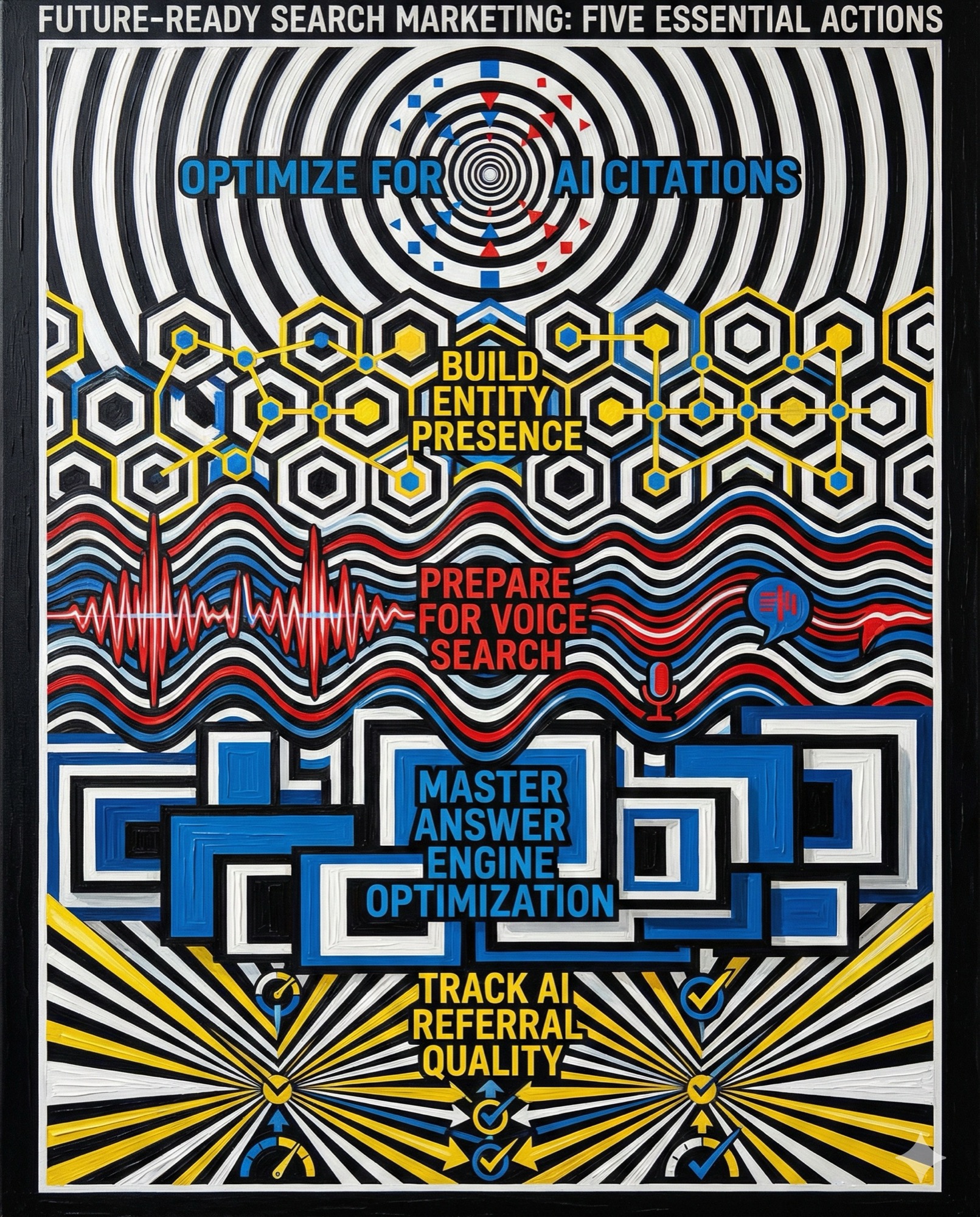
Adapting to the future of search requires specific actions, not just awareness.
Optimize for AI citations. Structure content so AI systems can easily extract and cite your information. Use clear definitions, numbered steps, and direct answers. Place your most important insights in formats that translate well to AI summaries.
Build entity presence. Establish your brand, authors, and key concepts in knowledge graphs and structured data. Schema markup helps AI systems understand your content's context and authority. The more clearly you define entities and their relationships, the better positioned you are for AI-driven search.
Prepare for voice search. Create conversational content that answers questions directly. FAQ structures, how-to formats, and Q&A content perform well for voice queries. Remember that voice results are 4.6 times more likely to come from featured snippets.
Master answer engine optimization. Ensure direct answers appear in your first 100 words. AI systems pull from content that gets to the point quickly. Comprehensive depth matters, but so does immediate relevance.
Track AI referral quality. Monitor traffic from ChatGPT, Perplexity, and other AI sources separately from traditional organic. With AI visitors worth 4.4 times more by conversion value, understanding this channel's performance is essential.
"SEO has entered a new era where machine learning has transformed the discipline from technical optimization into a strategic, intelligence-driven ecosystem."
— Whitepapers Online
Predictions for Search in 2026-2030
The trajectory is clear, even if the exact timeline remains uncertain.
According to industry projections, AI-powered tools will claim 10-14% of total search traffic by 2028. This represents hundreds of millions of queries shifting from traditional search engines to AI alternatives.
Thirty-six percent of US adults are expected to use generative AI for search by 2028, according to eMarketer. By 2031, total AI search users could exceed 1 billion globally.
Conversational AI is projected to handle 70% of customer interactions by 2027, fundamentally changing how businesses connect with audiences. The future of search isn't just about discovery. It's about the entire interaction paradigm shifting toward AI-mediated conversations.
Google isn't standing still. Gemini and AI Mode represent the company's response to these competitive pressures. But the era of Google's unchallenged dominance appears to be ending. ChatGPT's organic traffic trajectory suggests it could overtake traditional search for certain query types by 2028.
Why This Matters for Your Business
The future of search directly impacts how customers find you. If your strategy remains anchored to 2020-era SEO tactics, you're optimizing for a landscape that no longer exists.
This isn't about panic. It's about strategic adaptation. Businesses that understand how search is evolving can position themselves ahead of competitors still focused on outdated metrics.
The opportunity is substantial. AI search visitors convert at higher rates. Voice commerce is growing rapidly. Zero-click searches create challenges, but also create opportunities for brands that appear in AI-generated answers.
At Matt Kundo Digital Marketing, I help businesses navigate these transitions. The future of search marketing isn't about abandoning what works. It's about evolving strategies to match how people actually discover information today and how they'll discover it tomorrow.
Ready to Future-Proof Your Search Strategy?
The future of search is arriving faster than most businesses expect. AI Overviews, voice assistants, and answer engines are already reshaping how customers find products, services, and information.
Key takeaways:
- AI Overviews trigger in 30%+ of searches, dropping organic CTR by up to 34.5%
- ChatGPT processes 1 billion daily queries with 60.6% AI search market share
- Voice search accounts for 50%+ of global queries
- AI search visitors are 4.4x more valuable than traditional organic
- 10-14% of search traffic will shift to AI tools by 2028
Ready to adapt? The businesses that adapt now will capture opportunities while competitors struggle to catch up. If you're ready to develop a future-ready search strategy that accounts for AI, voice, and the changing discovery landscape, contact Matt Kundo Digital Marketing to discuss how we can help position your business for success.
Frequently Asked Questions
What is the biggest change in the future of search?
AI-powered answers through AI Overviews and answer engines are replacing traditional blue link results. According to Ahrefs, when AI Overviews trigger, click-through rates for the top organic position drop by 34.5%. This shift toward zero-click search represents the most significant change to organic visibility in years.
Will Google still dominate search in 2026?
Google maintains 89.6% global search market share, but faces real competition from AI alternatives. ChatGPT holds 60.6% of AI search market share, and Perplexity processes 30 million daily queries. Industry projections suggest 10-14% of search traffic could shift to AI tools by 2028.
How should I optimize for voice search?
Focus on conversational, question-answering content that directly addresses user queries. According to research, 71% of consumers prefer voice over typing, and voice results are 4.6 times more likely to come from featured snippets. Structure content with FAQ formats and natural language that matches how people speak.
Is SEO dead because of AI search?
No, but SEO is evolving significantly. Entity optimization, topical authority, and E-E-A-T matter more than keyword density. The opportunity remains substantial. According to Semrush, AI search visitors are 4.4 times more valuable than traditional organic visitors, making optimization for AI citation a high-value strategy.
What is answer engine optimization (AEO)?
Answer engine optimization focuses on getting your content cited by AI assistants like ChatGPT, Perplexity, and Google's AI Overviews. It emphasizes structured answers, credible sourcing, entity relationships, and content formats that AI systems can easily extract and synthesize.