

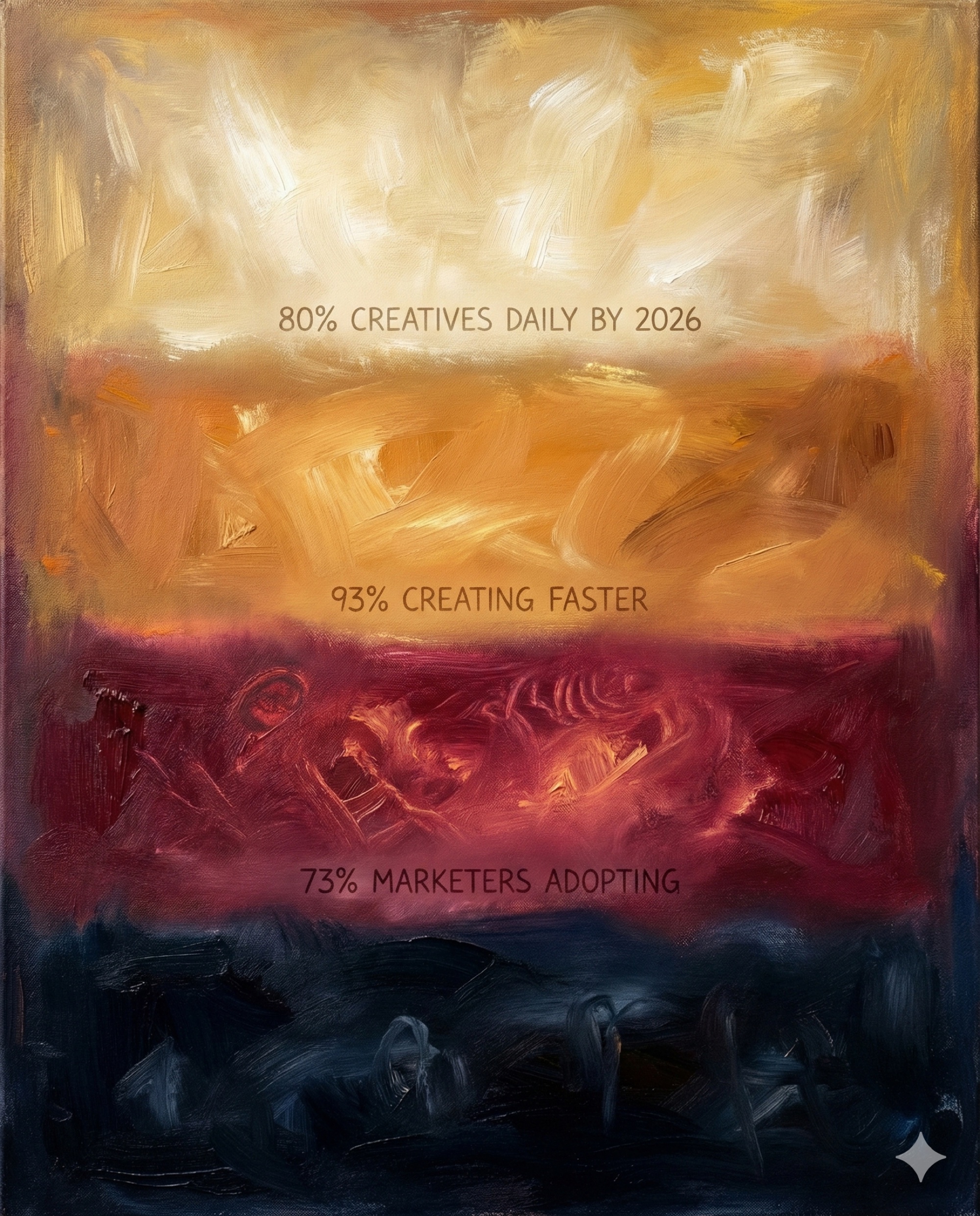
Generative AI for content creation has moved from experimental technology to essential marketing tool. According to Botco, 73% of marketing departments now use generative AI for image and text generation. McKinsey estimates this technology could add up to $4.4 trillion in annual economic value, with marketing and sales among the top beneficiaries.
Yet many marketers struggle to implement ai content marketing strategies that actually work. They either avoid AI entirely or rely on it too heavily, producing generic content that fails to connect with audiences. This guide provides a practical, step-by-step approach to using generative AI for content creation in 2026 and beyond.
You will learn what generative AI can do, why adoption is accelerating, and exactly how to implement a marketing content generation system that maintains quality while dramatically improving efficiency.
Table of Contents
What Is Generative AI for Content Creation?
Generative AI refers to artificial intelligence systems that create original content rather than simply analyzing existing data. These systems use large language models trained on vast datasets to produce text, images, video, and other media that did not exist before.
For marketers, this means AI can now handle tasks that previously required significant human time and effort. According to Semrush research, 58% of marketers use AI to create blog posts, 55% for social media content, and 49% for short articles. The technology handles email copy, ad creative, landing pages, and video scripts with increasing sophistication.
"AI is a tool. Maybe we use it to brainstorm. Or refine. Or edit. Or reimagine a blog post as a social post... AI is a robot perched on our shoulder, not the creator at the keyboard."
- Ann Handley, Chief Content Officer at MarketingProfs
This distinction matters. Generative AI excels at producing first drafts, generating variations, and handling repetitive content tasks. It struggles with original thought, brand voice nuance, and the kind of insight that comes from genuine expertise. Understanding these boundaries is essential to successful implementation.
Why Marketers Are Adopting AI Content Tools in 2026
The business case for generative AI in content creation rests on measurable outcomes that align with marketing goals.
Speed and Efficiency
According to SEO.com research, 93% of marketers say AI helps them create content faster. This acceleration addresses one of marketing's persistent challenges: the need to produce more content across more channels without proportionally increasing resources or sacrificing quality.
Performance Improvements
Semrush data shows 71% of marketers using AI rate their content performance as effective or very effective. Additionally, 81% report that AI helps boost brand awareness and sales. These are not marginal improvements but substantial gains that justify the investment in AI tools and workflows.
Daily Integration
AI marketing statistics indicate 88% of marketers now use AI daily in their work. This level of adoption suggests AI has moved beyond experimentation into core marketing operations. The question is no longer whether to adopt AI but how to optimize its use.
Creative Amplification
Perhaps most importantly, 76% of marketers use AI for creative inspiration, and 58% use it for research and ideation. This positions AI not as a replacement for human creativity but as a tool that expands creative possibilities.
"AI is changing the game for marketers at the moment. If you aren't adopting AI in your day to day processes, the risk of falling behind your competitors becomes greater and greater."
- Dan Shaffer, Director at SEO.com

How to Implement Generative AI for Content Creation
Successful implementation requires a systematic approach that balances AI capabilities with human oversight. Follow these six steps to build an effective marketing content generation system.
Step 1: Define Your Content Goals and Use Cases
Start with high-volume, lower-risk content tasks where AI can provide immediate value without significant quality risks. Blog post drafts, social media updates, email subject lines, and ad copy variations are ideal starting points.
Map specific content challenges to AI capabilities. If your team struggles to produce enough social content, begin there. If email open rates need improvement, use AI to generate and test subject line variations. This targeted approach builds experience while delivering measurable results.
Set clear KPIs before implementation. Track time savings, output volume increases, and performance metrics from the start. This baseline data proves essential for optimization and stakeholder communication.
Step 2: Choose the Right AI Content Tools
The AI content tool landscape offers options for every need and budget. General-purpose large language models like ChatGPT (which holds 62.5% market share with 525.9 million monthly visitors), Claude, and Gemini provide flexible content generation capabilities.
SEO and content marketing suites including Semrush, Surfer, and Clearscope integrate AI with optimization features. Marketing platforms like HubSpot and Salesforce Einstein embed AI into existing workflows. Dedicated writing tools such as Jasper and Copy.ai specialize in marketing content, while design tools like Canva AI and Adobe Firefly handle visual content.
Most organizations benefit from combining one general-purpose LLM with platform-specific tools that integrate with their existing technology stack.
Step 3: Build Your Prompt Library and Style Guide
Effective AI content requires effective prompts. Create reusable prompt templates for each content type your team produces. These templates should encode brand voice, messaging pillars, and formatting requirements directly into the instructions.
Document tone variations for different personas and funnel stages. A prompt for awareness-stage blog content should produce different results than one for decision-stage sales emails. Build these distinctions into your prompt library from the start.
"AI should feel like a copilot for marketers and salespeople - helping them write emails, blog posts, and landing pages faster, while still sounding like their brand."
- Yamini Rangan, CEO of HubSpot
Step 4: Establish Human-in-the-Loop Workflows
Never publish AI-generated content without human review. This principle protects brand reputation, ensures accuracy, and maintains the quality standards your audience expects.
Design workflows where AI generates initial drafts and humans review for brand voice alignment, factual accuracy, and compliance requirements. The human editor adds the insight, nuance, and judgment that AI cannot provide.
"Marketing leaders who treat generative AI as a strategic assistant for content - to draft, adapt, and localize assets - will see faster cycle times and more consistent messaging across channels."
- Gartner

Step 5: Create an AI Governance Framework
Establish clear policies for AI use in your organization. Define which tools are approved, what data sources are acceptable, and how review and approval processes work.
Set standards for first-party data usage, attribution and disclosure practices, and fact-checking protocols. Document hallucination prevention measures, including verification steps for statistics, quotes, and technical claims.
This governance framework protects your organization while enabling teams to use AI confidently within established boundaries.
Step 6: Measure and Optimize Performance
Track before-and-after metrics across key dimensions: time to produce content, total output volume, click-through rates, engagement metrics, and downstream conversions. Segment results by AI-assisted versus human-only content to understand where AI adds the most value.
Use performance data to continuously refine prompts and workflows. The most successful teams treat AI implementation as an ongoing optimization process rather than a one-time setup.
Common Challenges and How to Overcome Them
Implementation rarely proceeds without obstacles. Understanding common challenges helps you address them proactively.
Maintaining Quality and Originality
Semrush research shows 24% of content marketers struggle with producing original, high-quality content. AI can exacerbate this challenge when used as a shortcut rather than a tool.
The solution lies in positioning AI for drafts and humans for refinement. As Ann Handley notes: "Generative AI burps out alllll the content we could possibly need. Our differentiator is only this: our taste, perspectives, experiences, and the ability to tell true stories with a bit of inspired joy."
Preserving Brand Voice
Generic AI output risks diluting the distinctive voice that sets your brand apart. Combat this through detailed style guides incorporated into prompts and by training AI on examples of your existing brand content.
Adapting to Search Changes
Typeface research indicates Google AI Overviews have reduced click-through rates by approximately 30%. Content strategies must evolve to optimize for AI assistants and semantic search, not just traditional rankings.
Building Trust and Authenticity
Europol estimates that by 2026, up to 90% of online content may be AI-generated. In this environment, human expertise and authentic perspective become premium differentiators.
"We see a future where every piece of content is co-created with AI in some way, but the vision, the taste, the judgment - that still comes from people."
- Shantanu Narayen, CEO of Adobe
The Future of AI Content Creation in 2026 and Beyond
Several trends will shape how marketers use generative AI for content creation in the coming years.
Gartner projects that by 2026, 80% of creative talent will use generative AI daily. This widespread adoption will make AI proficiency a baseline expectation rather than a competitive advantage.
Search continues evolving around AI assistants. With AI Overviews appearing for more than 10% of keywords and growing, content must serve AI systems as well as human readers. Structured, semantically rich, authoritative content becomes essential.
Hyper-personalization reaches new levels as AI enables real-time, persona-specific content versions. Dynamic emails, landing pages, and ad creatives tailored to individual preferences become standard practice.
Marketing roles evolve accordingly. Research indicates 75% of marketing work is shifting toward strategy rather than execution. Content teams become AI-augmented strategists who guide and refine AI output rather than producing every word themselves.
"AI is going to significantly lower the barrier to creation. If you can describe what you want in language, you'll be able to create it - text, images, video, code - and then refine it with your own judgment and taste."
- Sundar Pichai, CEO of Google
Start Your AI Content Journey Today
Generative AI for content creation offers proven benefits: faster production, improved performance, and the ability to scale without sacrificing quality. Success requires treating AI as a strategic assistant rather than an autonomous content machine.
Begin with a single use case where AI can provide immediate value. Build workflows that combine AI efficiency with human oversight. Measure results and optimize continuously.
The statistics are clear: 92% of businesses plan to invest in AI marketing capabilities. The question is not whether your competitors will adopt these tools but how quickly you can implement them effectively.
Ready to transform your content marketing with AI? Contact our team to discuss how our AI-powered marketing services can help you achieve your content goals.
Sources
- Botco - AI Marketing Statistics: 73% of Marketing Departments Use Generative AI (2025)
- McKinsey - The Economic Potential of Generative AI: $4.4 Trillion Value (2024)
- Semrush - AI Content Creation Statistics and Research (2025)
- SEO.com - AI Marketing Statistics: 93% Create Content Faster (2025)
- Gartner - 80% of Creative Talent Will Use Generative AI Daily by 2026 (2024)
- Typeface - Google AI Overviews Impact on Click-Through Rates (2025)
- Europol - Impact of Large Language Models: 90% AI-Generated Content Projection (2024)