
Real talk—the way people search has fundamentally changed, and most businesses haven't caught up. When your potential customer asks ChatGPT for a recommendation or gets an answer from Google's AI Overview, traditional SEO alone won't get you mentioned. That's where a generative AI search engine optimization agency comes in. I've spent the last year diving deep into generative engine optimization (GEO), testing what works across AI platforms, and here's what I've learned about finding the right partner to help your brand get cited in AI-generated answers.
What Does a Generative AI SEO Agency Do?
A generative AI search engine optimization agency specializes in optimizing your digital presence for AI-powered search platforms. Unlike traditional SEO agencies that focus primarily on ranking in Google's link-based search results, a GEO agency ensures your content gets cited, referenced, and recommended when AI systems like ChatGPT, Perplexity, Google AI Overviews, and Claude synthesize answers for users.
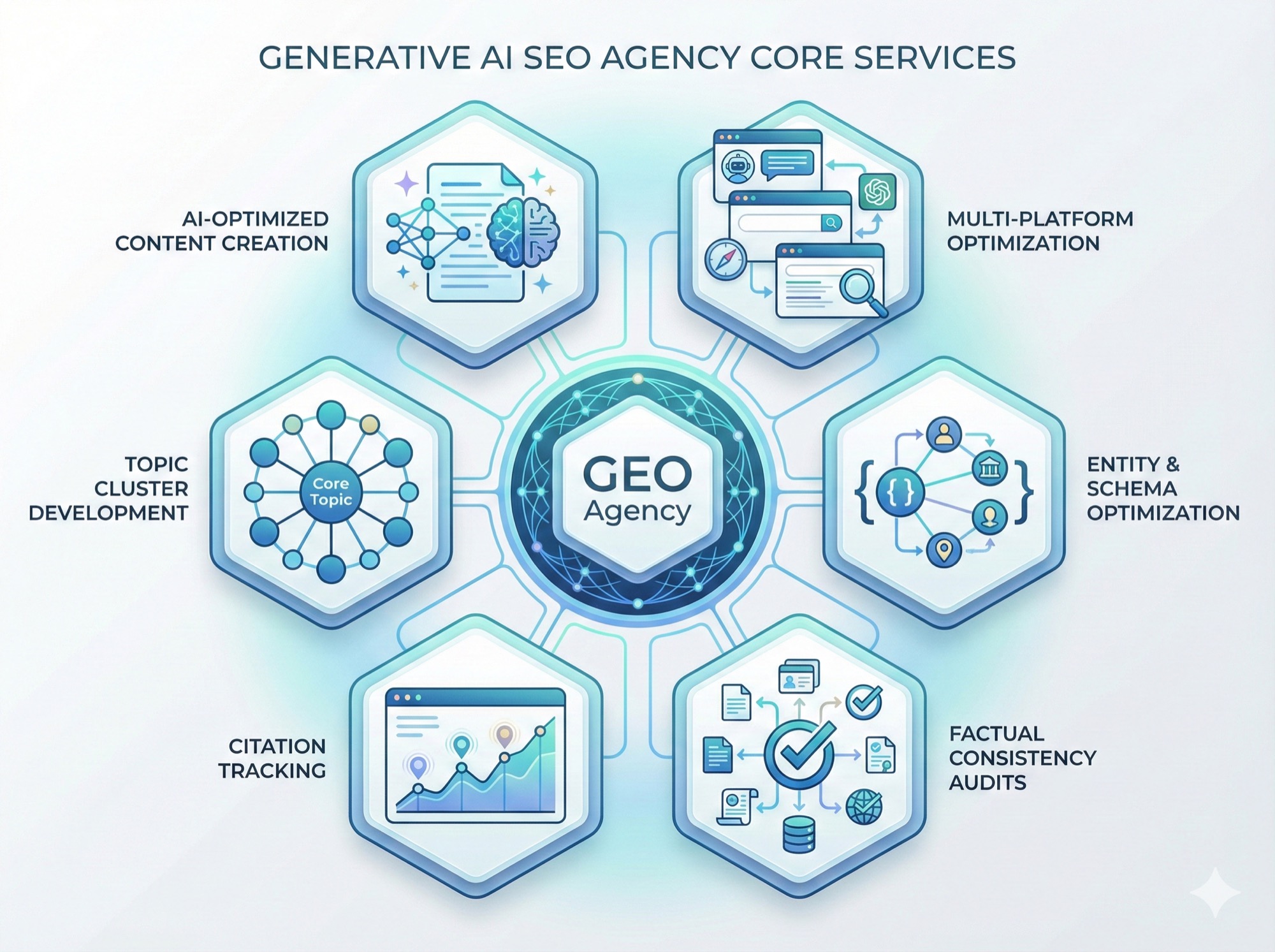
The core services offered by a generative AI SEO agency typically include:
Content Optimization for AI Citation: Creating content that large language models (LLMs) can easily extract, understand, and cite. This means structuring information in quotable, factual formats that AI systems recognize as authoritative.
Entity and Knowledge Graph Optimization: Building clear connections between your brand, products, and services in how AI systems understand relationships. This involves structured data implementation, consistent NAP information, and deliberate entity-building strategies.
AI Platform Monitoring and Testing: Regularly testing how your brand appears across generative engines—ChatGPT, Perplexity, Claude, Google Gemini—and adjusting strategies based on actual AI responses.
E-E-A-T Signal Enhancement: Strengthening the Experience, Expertise, Authoritativeness, and Trustworthiness signals that both traditional search engines and AI systems use to evaluate content credibility.
The key difference from traditional SEO services is the target outcome. Traditional SEO measures success in rankings and clicks. Generative AI SEO measures success in AI citations and brand mention share-of-voice across AI platforms.
Why Businesses Need GEO Agency Services in 2026
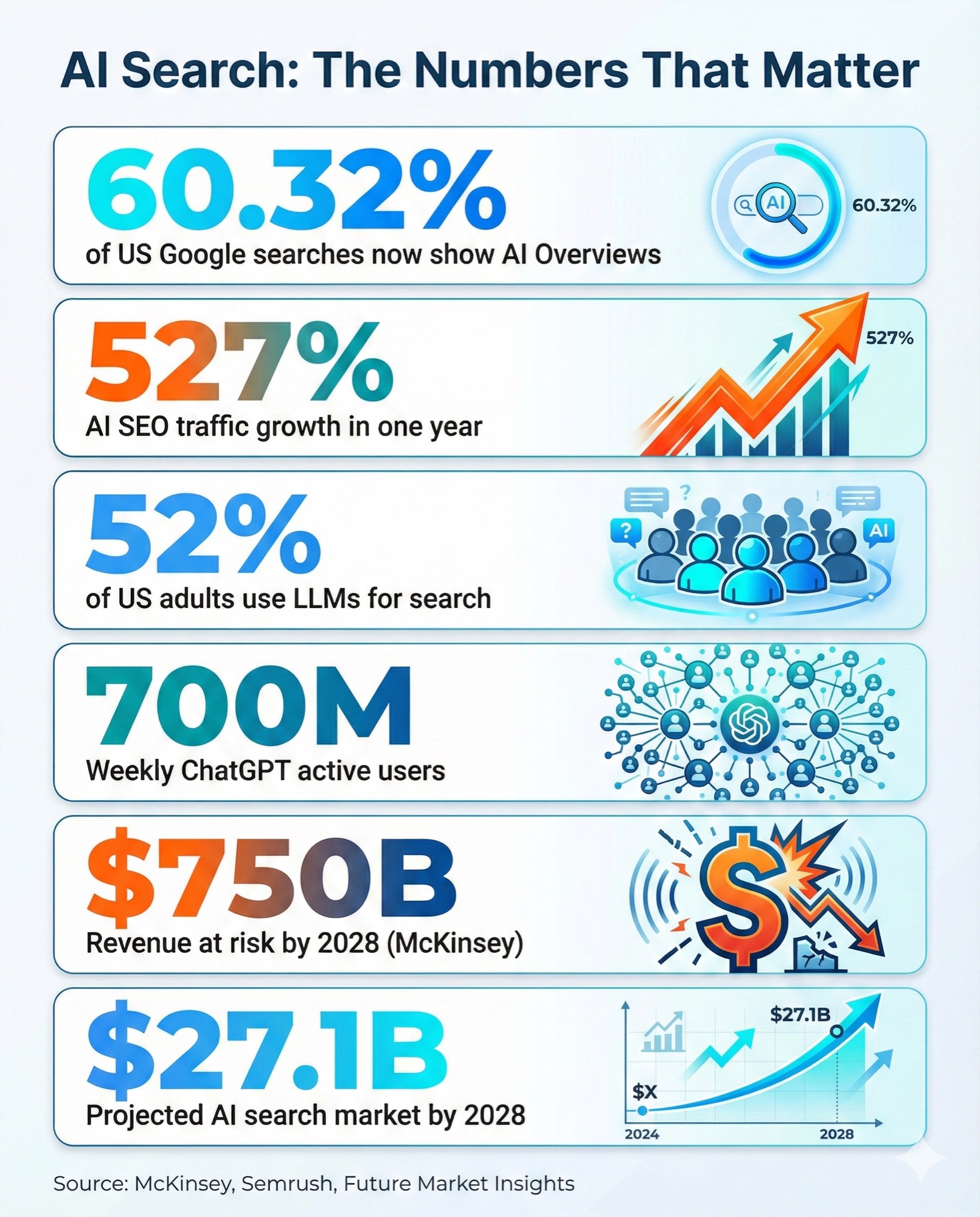
The numbers tell a compelling story about why generative AI search engine optimization matters now.
According to Valuates Reports, the global GEO services market was valued at $886 million in 2024 and is projected to reach $7.318 billion by 2031—a 34% compound annual growth rate. This explosive growth reflects the fundamental shift in how people find information online.
The adoption statistics are equally striking. According to Wellows, 38% of users now regularly use AI tools like ChatGPT, Perplexity, and Google Gemini for search-style queries. That's nearly four in ten Americans reaching for AI assistants when they have questions.
The impact on traditional search behavior is significant. When AI-generated answers appear in search results, organic click-through rates drop by 54%—from 1.41% to just 0.64% for informational queries. Zero-click searches now account for nearly 60% of all Google searches in the US and EU, a trend accelerated by AI integration.
Gartner predicts that by 2028, up to 25% of all searches will move to generative engines entirely. Businesses that wait to adapt risk losing significant visibility as search behavior continues shifting.
The business case is clear: if you're not showing up in AI-generated answers today, you're already missing a growing segment of potential customers.
GEO vs Traditional SEO: What's Different?
Understanding the distinction between generative engine optimization and traditional search engine optimization helps clarify what services you actually need.
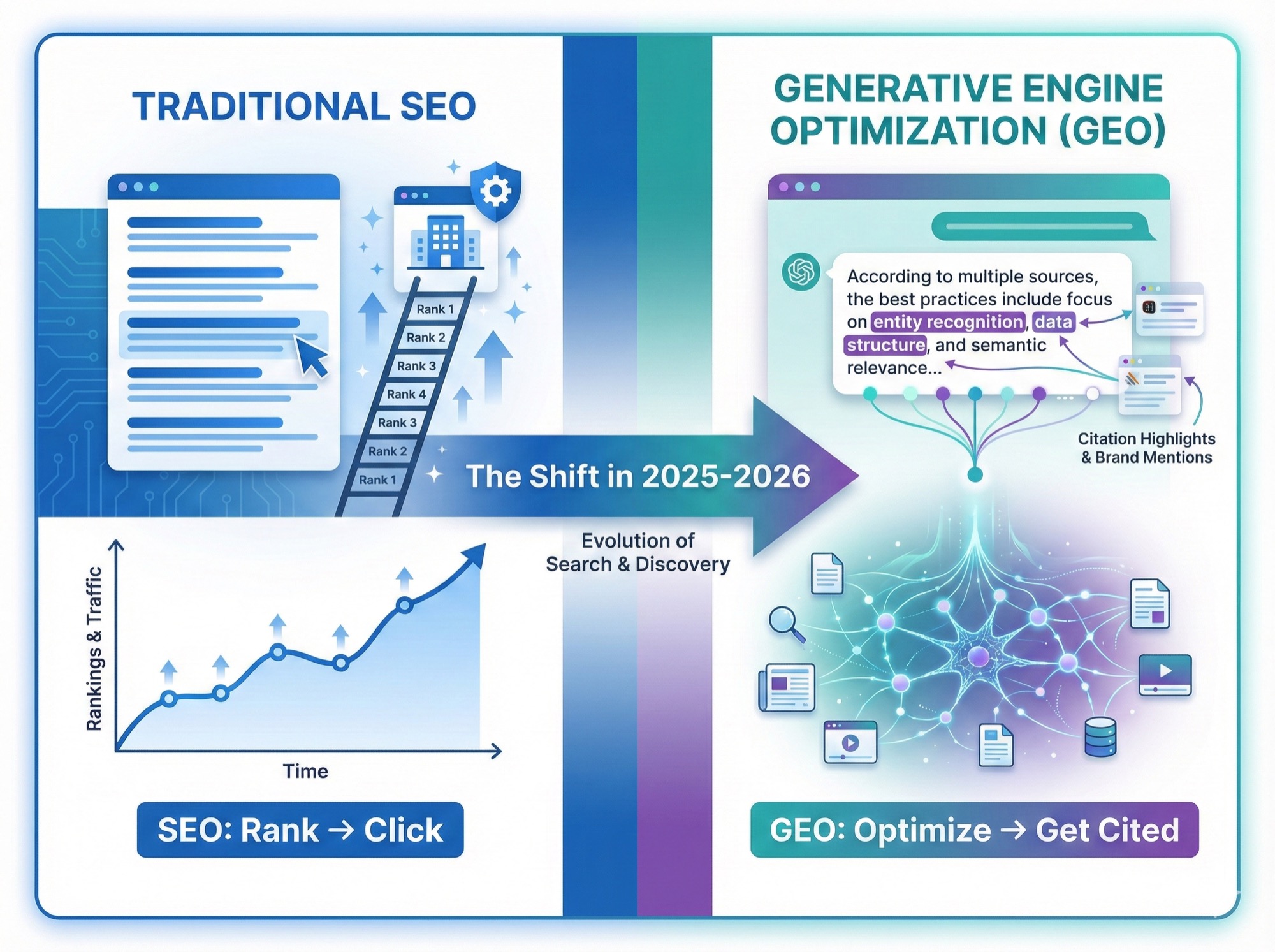
| Aspect | Traditional SEO | Generative AI SEO |
|---|---|---|
| Primary Goal | Rank in SERPs | Get cited in AI answers |
| Success Metrics | Rankings, clicks, traffic | AI citations, share-of-voice |
| Content Focus | Keyword-optimized | Entity-optimized, quotable |
| Technical Focus | Meta tags, backlinks | Schema markup, knowledge graphs |
| Target Platforms | Google, Bing | ChatGPT, Perplexity, AI Overviews, Claude |
Traditional SEO focuses on convincing search engine algorithms that your page deserves to rank for specific keywords. You optimize meta tags, build backlinks, and structure content around keyword placement and density.
Generative AI SEO focuses on convincing large language models that your brand is a credible source worth citing. You optimize for entity recognition, create quotable content blocks, implement structured data that AI systems can interpret, and build authority signals that LLMs use to determine trustworthiness.
The strategies complement each other. Strong traditional SEO provides the foundation—if you don't rank, AI systems may never encounter your content during their training or retrieval processes. But ranking alone doesn't guarantee AI citation. A generative AI search engine optimization agency combines both approaches into a unified strategy.
According to First Page Sage, GEO adoption among companies rose from 61% in Q3 2023 to 85% by Q2 2025, while customer acquisition costs for GEO-focused strategies fell 37.5%—from $895 to $559. The integration of GEO with traditional SEO is becoming standard practice.
Key Services to Look for in a GEO Agency
When evaluating a generative AI search engine optimization agency, look for these specific capabilities:
1. AI Platform Auditing
A qualified GEO agency should test your brand's visibility across multiple generative engines—not just ChatGPT. This includes Perplexity (which holds 6.2% of AI search market share), Google Gemini (13.5% market share), Claude, and Microsoft Copilot. According to Wellows, ChatGPT dominates with 59.7% market share, but ignoring other platforms means missing significant audiences.
2. Entity Optimization
Effective generative SEO services include building your brand's presence in knowledge graphs and structured data ecosystems. This means implementing schema markup, ensuring consistent entity information across the web, and creating clear relationships between your brand and relevant topics.
3. Content Structuring for AI Extraction
AI systems extract information differently than humans read it. A GEO agency should help you create content with clear, quotable statements, properly attributed statistics, and structured formats that LLMs can easily parse and cite.
4. E-E-A-T Enhancement
Experience, Expertise, Authoritativeness, and Trustworthiness matter even more in AI search than traditional SEO. Generative engines rely heavily on these quality signals when determining which sources to cite. Look for agencies that understand how to build demonstrable expertise signals.
5. Performance Tracking
Traditional SEO metrics don't capture GEO success. Ask potential agencies how they measure AI citation share-of-voice, track brand mentions across generative platforms, and attribute business outcomes to AI search visibility.
6. Technical SEO Integration
GEO doesn't replace technical SEO fundamentals—it builds on them. Your generative AI search engine optimization agency should understand how site architecture, page speed, mobile optimization, and crawlability affect both traditional rankings and AI system access to your content. AI platforms like Perplexity actively crawl websites, making technical health equally important for GEO success.
Red flags to watch for: Agencies that don't have an AI-specific methodology, can't explain how they measure GEO performance, or treat GEO as just "SEO with different keywords" likely lack the specialized expertise this work requires. Also watch for agencies that claim to guarantee specific placements in AI responses—no one can guarantee how LLMs will respond to queries.
How to Evaluate a Generative AI SEO Agency
Before engaging any generative AI search engine optimization agency, ask these questions:
What AI platforms do you optimize for?
The answer should include ChatGPT, Perplexity, Google AI Overviews, Claude, and Gemini at minimum. An agency focused only on one platform misses the broader AI search landscape.
How do you measure success in AI search?
Look for specific methodologies—citation tracking, AI share-of-voice monitoring, before/after testing across platforms. Vague answers like "we track rankings" suggest traditional SEO thinking applied to a different problem.
What's your approach to entity optimization?
Strong answers reference structured data implementation, knowledge graph building, and entity relationship mapping. Weak answers focus only on keyword placement.
Can you show case studies with AI citation improvements?
The best generative SEO services providers document measurable improvements in AI visibility—not just traditional SEO metrics applied to new keywords.
How do you balance GEO with traditional SEO?
The answer should describe an integrated approach. Traditional SEO builds the foundation; GEO ensures AI systems recognize and cite your content. Neither works optimally in isolation.
According to MarketingLTB, 86% of enterprise SEO teams have already integrated some AI into their work, and 82% plan additional AI investment. Meanwhile, 56% of marketers are already using generative AI in their SEO workflows. The question isn't whether to invest in GEO—it's how to choose the right partner.
Timeline expectations matter too. Unlike traditional SEO where results typically take 3-6 months, GEO results can appear faster since you're optimizing for how AI systems interpret existing content. However, sustainable AI visibility still requires ongoing optimization as models update and competitive landscapes shift. Be wary of agencies promising overnight results—quality GEO is a strategic investment, not a quick fix.
Getting Started with Generative AI SEO
Deciding when to engage a generative AI search engine optimization agency depends on your current situation.
Consider GEO services if:
- Your brand appears inconsistently or incorrectly in AI-generated answers
- Competitors are getting cited in AI responses while you're not mentioned
- You've invested in traditional SEO but see diminishing returns
- Your target audience increasingly uses AI assistants for research
- You operate in industries where AI search adoption is accelerating
The cost of waiting is real. According to research from Perplexity AI, their platform recorded 153 million website visits in May 2025—up 191.9% year-over-year from 52.4 million in March 2024. Google's AI Overviews have reached over 1.5 billion monthly users. Every month you delay GEO investment, competitors are establishing their presence in these AI-generated answers while your brand remains invisible.
Ready to improve your AI search visibility? At Matt Kundo Digital Marketing, I approach generative engine optimization as an extension of foundational SEO work—not a replacement for it. The goal is ensuring your brand gets recognized, cited, and recommended whether customers find you through traditional search, AI assistants, or the increasingly common AI Overview at the top of Google results.
If you're ready to evaluate how your business appears across AI platforms and what it would take to improve that visibility, let's talk. The shift to AI-powered search isn't coming—it's already here.
Sources
- Valuates Reports – GEO Services Market to Hit $7.3B by 2031
- Wellows – Generative Engine Optimization Statistics 2025
- First Page Sage – GEO Customer Acquisition Cost Benchmarks
- MarketingLTB – GEO Statistics and Trends
- Insightland – Generative Engine Optimization Guide for 2025
- Sequencr.ai – GEO Key Statistics and Trends 2025