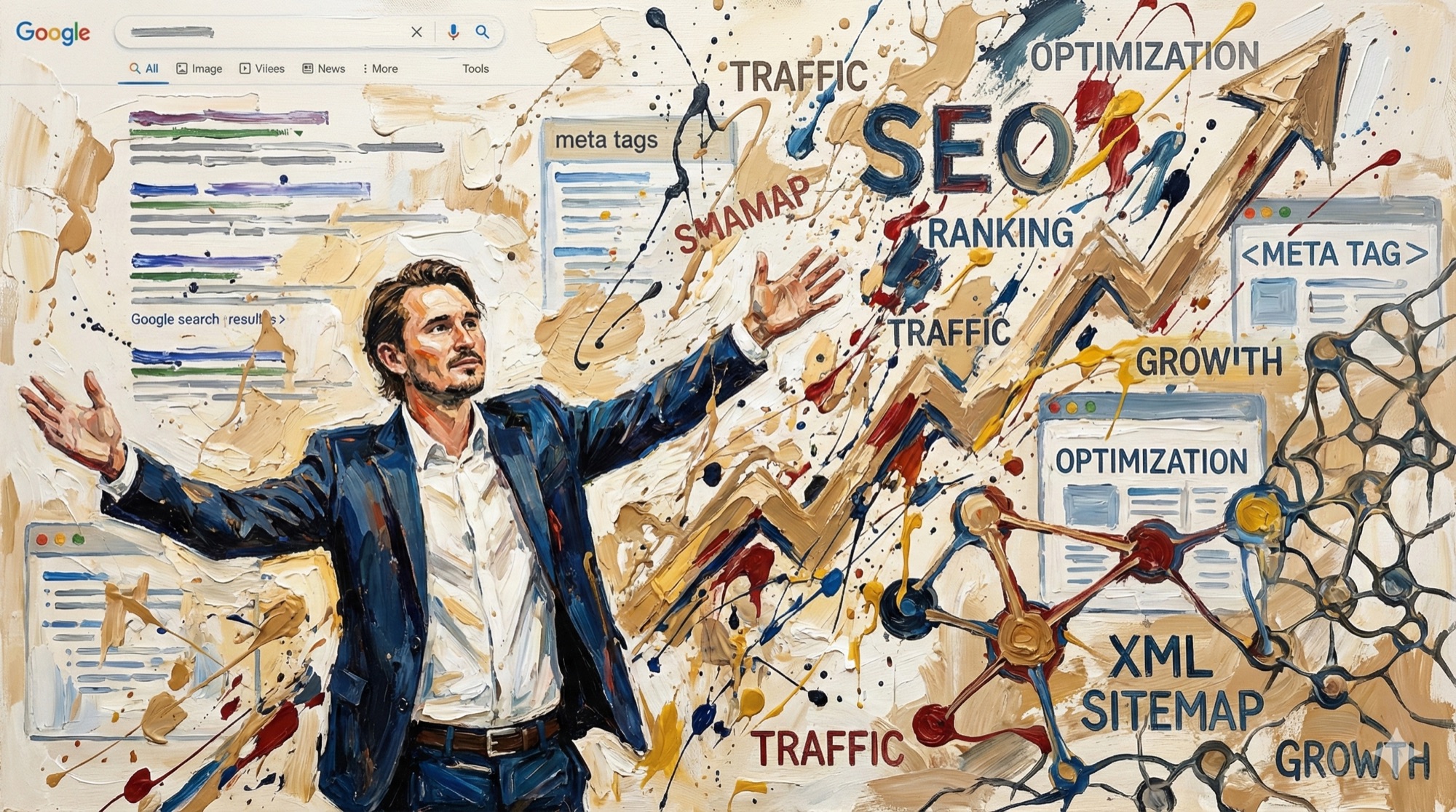
Most websites are completely invisible to Google. According to SE Ranking, 94% of pages on the internet get zero traffic from search engines. I've watched countless business owners pour time and money into beautiful websites that nobody ever finds. The good news? Adding search engine optimization to your website isn't as complicated as the SEO industry wants you to believe.
In this guide, I'll walk you through exactly how to add search engine optimization to your website, step by step. Whether you're starting from scratch or improving an existing site, these techniques will help you improve search engine results and climb higher in keyword rankings. This connects directly to the broader shift toward generative engine optimization, where traditional SEO meets AI-powered search.
To add search engine optimization to your website, start with technical foundations like site structure, XML sitemaps, and page speed. Then optimize on-page elements including title tags, meta descriptions, and header tags. Create quality, keyword-targeted content, build authoritative backlinks, and track performance with Google Analytics and Search Console. SEO delivers up to 700% ROI when executed as a long-term strategy, according to SeoProfy.
Table of Contents
- What You'll Need Before Starting
- Step 1: Set Up Your Technical SEO Foundation
- Step 2: Optimize Your On-Page Elements
- Step 3: Create Quality, Keyword-Optimized Content
- Step 4: Build Quality Backlinks
- Step 5: Measure and Improve Your SEO Results
- SEO Trends to Watch in 2026
- When to Hire an SEO Professional
- Start Improving Your Search Engine Results Today
What You'll Need Before Starting
Before you dive into optimization, gather these essentials:
- Access to your website backend or CMS (WordPress, Squarespace, Wix, or your hosting control panel)
- A free Google Search Console account to monitor how Google sees your site
- A free Google Analytics account to track visitor behavior
- A list of target keywords including your primary keyword and 3-5 secondary keywords
- Understanding of your target audience and what they're searching for
If this already feels overwhelming, that's completely normal. I work with professional SEO services clients who come to me after trying to tackle this alone. The key is taking it one step at a time.
Step 1: Set Up Your Technical SEO Foundation
Technical SEO ensures search engines can find, crawl, and understand your website. Without this foundation, all your content efforts are wasted.
Here's what to do:
- Submit an XML sitemap to Google Search Console. Your sitemap lists every important page on your site, helping Google discover your content faster.
- Check your robots.txt file to verify it allows crawling of important pages. Find it at yoursite.com/robots.txt.
- Enable HTTPS with an SSL certificate. Google prioritizes secure sites, and users expect that padlock icon.
- Fix broken links and 404 errors using tools like Screaming Frog or the free version of Ahrefs.
- Ensure mobile responsiveness. With 62.73% of global website traffic coming from smartphones according to Statista, mobile-first design isn't optional.
- Improve page load speed. Average mobile page load time is a painful 8.6 seconds according to ToolTester, but your goal should be under 3 seconds.
Only 51.8% of websites meet recommended Core Web Vitals performance standards, according to Chrome for Developers. Getting this right puts you ahead of half your competition immediately.
"Consistency is the biggest technical SEO factor."
— John Mueller, Google Search Advocate
Success criteria: Your site appears in Google Search Console's index coverage report, passes Google's mobile-friendly test, and shows green scores in PageSpeed Insights.

Step 2: Optimize Your On-Page Elements
On-page SEO is where you tell search engines exactly what each page is about. These elements directly impact how your pages appear in search results.
Follow these steps:
- Write compelling title tags under 60 characters that include your primary keyword near the beginning. Every page needs a unique title.
- Craft meta descriptions of 150-160 characters with a clear call-to-action. While Google rewrites 60-70% of meta descriptions according to Search Engine Journal, well-written ones still influence click-through rates.
- Structure content with header tags. Use one H1 per page containing your primary keyword, then H2s and H3s to organize sections logically.
- Create SEO-friendly URLs. Keep them short, descriptive, and hyphenated. URLs that include words related to a keyword have a 45% higher click-through rate according to Backlinko.
- Add alt text to all images describing what the image shows. This helps search engines understand visual content and improves accessibility.
- Build internal links between related pages using descriptive anchor text. This distributes link equity and helps users navigate your site.
Success criteria: Every page has a unique title tag, meta description, proper header hierarchy, and descriptive URLs.
Step 3: Create Quality, Keyword-Optimized Content
Content remains the backbone of search engine optimization. You can't improve keyword rankings without content that answers what people are searching for.
Here's the process:
- Conduct keyword research using tools like Google Keyword Planner, Semrush, or Ahrefs. Identify a primary keyword and 3-5 secondary keywords for each page.
- Map keywords to pages with one primary keyword per page. Don't try to rank a single page for everything.
- Write comprehensive content that thoroughly answers the user's question. Think depth over fluff.
- Include your primary keyword naturally in the first 100 words, in at least one H2, and throughout the content at a 1-2% density.
- Use semantically related words to give search engines context. For SEO content, this includes terms like search results, meta description, site structure, and user experience.
- Update content regularly to maintain freshness. Search engines favor recently updated information.
According to HubSpot's State of Marketing Report, 39% of marketers list optimizing on-page content based on keywords as their top SEO strategy. It's not glamorous, but it works.
"Focus on 10x content: Create content that's 10 times better than the top-ranking pages in terms of depth, freshness, and user value."
— Rand Fishkin, Co-founder of Moz and SparkToro
For a deeper dive into keyword placement, check out my guide on keyword optimization strategies.
Success criteria: Content matches search intent, keywords appear naturally, and pages comprehensively cover the topic.

Step 4: Build Quality Backlinks
Backlinks remain one of Google's most important ranking signals. When authoritative sites link to your content, it signals trust and relevance.
Effective approaches:
- Create link-worthy content like original research, comprehensive guides, and useful tools. People link to genuinely valuable resources.
- Guest post on relevant industry sites. Offer genuine value to their audience, and earn a link back to your site.
- Find broken link opportunities. When you discover broken links on other sites, offer your content as a replacement.
- Get listed in relevant directories and citation sites. For local businesses, this is especially important.
- Earn mentions through digital PR. Newsworthy stories, expert commentary, and original data attract natural links.
"Find link-worthy content, create something better, and reach out to the linkers."
— Brian Dean, Founder of Backlinko (Skyscraper Technique)
Quality matters more than quantity. A single link from an authoritative industry site outweighs dozens of links from irrelevant sources.
Success criteria: Gradual increase in backlinks from relevant, authoritative domains tracked via Ahrefs or Moz.
Step 5: Measure and Improve Your SEO Results
Search engine optimization isn't a one-time project. You need to measure, analyze, and improve continuously.
Set up your measurement system:
- Configure Google Search Console to track impressions, clicks, click-through rate, and average position for your target keywords.
- Set up Google Analytics 4 with conversion goals to understand how organic traffic contributes to business outcomes.
- Monitor keyword rankings weekly using tools like Semrush, Ahrefs, or the free version of Ubersuggest.
- Track organic traffic growth month-over-month. Look for steady upward trends.
- Analyze user behavior including bounce rate, time on page, and pages per session. Low engagement signals content problems.
- Iterate based on data. Double down on what's working, fix what's not.
The data tells a clear story about why rankings matter. According to Backlinko, the first Google result gets 27.6% of clicks, while positions 2 and 3 get 15.8% and 11% respectively. Moving up just one position increases click-through rate by 2.8% on average.
Success criteria: Dashboards configured, baseline metrics established, consistent tracking rhythm in place.

SEO Trends to Watch in 2026
Search is evolving rapidly, and staying ahead means understanding where it's heading.
Key trends to prepare for:
- AI-powered search is growing fast. In 2024, roughly 15 million U.S. adults primarily used generative AI for search. Statista projects this will rise to over 36 million by 2028.
- Visual search is exploding. Over 1.5 billion people use Google Lens every month, with more than 100 billion visual searches recorded according to Think with Google.
- E-E-A-T matters more than ever. Experience, Expertise, Authoritativeness, and Trustworthiness continue to influence how Google evaluates content quality.
- Core Web Vitals keep evolving. Page experience signals will only become more important.
"Create comprehensive content hubs around core topics to build topical authority and improve internal linking."
— Neil Patel, Co-founder of NP Digital
When to Hire an SEO Professional
SEO is absolutely something you can learn and implement yourself. But there are times when professional help makes sense.
Consider hiring an expert if:
- You've been optimizing for 6+ months with no ranking improvements
- Technical issues are beyond your comfort level
- You're in a highly competitive industry
- Your time is better spent on core business activities
- You need a comprehensive audit and strategy
Professional SEO services typically show results within 3-6 months, though competitive keywords may take longer. The right partner brings experience, tools, and dedicated time that most business owners simply can't match.
Ready to accelerate your SEO results? I help businesses at Matt Kundo Digital Marketing cut through the SEO confusion and focus on what actually drives measurable results. Check out my SEO and content marketing services designed for businesses serious about organic growth.
Start Improving Your Search Engine Results Today
Adding search engine optimization to your website isn't a mystery. It's a systematic process of technical setup, on-page optimization, quality content creation, backlink building, and continuous measurement.
Here's what I want you to remember:
- Start with technical foundations. XML sitemaps, mobile responsiveness, and page speed come first.
- Optimize every page element. Title tags, meta descriptions, headers, and URLs all matter.
- Create content that deserves to rank. Answer questions better than anyone else.
- Build authority through backlinks. Quality over quantity, always.
- Measure and iterate. Data-driven decisions beat guesswork every time.
The businesses that win at SEO aren't necessarily the biggest or most well-funded. They're the ones that commit to the process and stay consistent.
Ready to improve your search engine results and stop being invisible to Google? I'd love to help you build a strategy that actually moves the needle. Get in touch to discuss how I can help you maximize search engine optimization for your business.