
Understanding the systems that determine your online visibility
SEO isn't magic. It's knowing how Google's ranking system really works. Once you get that, the whole game changes. Let me show you how search engines pick winners... and how you can work with the system instead of fighting it.
An SEO algorithm is a ranking system that search engines like Google use to score and rank web pages. These systems look at content quality, user signals, site trust, and page speed to decide who ranks first. Google reps say over 200 factors shape where your site shows up. Knowing how SEO algorithms work helps you craft content that gets seen.
In March 2025, the latest core update hit 53% of domains, per SEMrush Sensor Data. This shows just how fast these systems change... and why staying current on SEO trends matters so much.
Table of Contents
What Is an SEO Algorithm?
An SEO algorithm is the system search engines use to pick which pages show up and in what order. Google's algorithm for SEO checks hundreds of signals to match what users type with the best content on the web.
Search engines use these systems to handle billions of searches each day. The algorithm's job is to figure out what users want, find content that fits, and rank results by quality. Per recent SEO research, 75% of users never scroll past page one. That's why ranking well matters so much.
The SEO algorithm works in three main steps. First, bots crawl the web to find new pages. Second, those pages get stored in a huge index. Third, the system ranks them by how well they match the search and serve the user.
Knowing how Google's algorithm for SEO works gives site owners a real edge. SEO research shows SEO leads close at 14.6%, versus 1.7% for outbound leads. That makes organic search one of the best ways to drive quality traffic to your business.
SEO algorithms have changed a lot. Early systems just matched keywords and counted links. Today's search uses machine learning, AI that reads context, and user behavior data to get better results. For insights into where search algorithms are headed, see our analysis of the future of search. For a full look at how search works, see Google's How Search Works guide.
How Google's SEO Algorithm Works in 2026
In 2026, Google's SEO algorithm runs on many linked AI systems. Each one handles a specific part of search quality. Knowing what they do helps you tune your site to match how the system really works.
RankBrain was Google's first major machine learning system for search, introduced in 2015. It helps the algorithm understand the meaning behind queries, especially those the system hasn't seen before. Gary Illyes, Webmaster Trends Analyst at Google, explains: "RankBrain is one of the hundreds of signals that go into an algorithm that determines what results appear on a Google search page and where they are ranked."
BERT came in 2019 and changed how the SEO algorithm reads text. It looks at words in context, not alone. That lets it catch small shifts in meaning, like how one word can flip a sentence's intent.
MUM is the next big leap. Google says MUM is 1000 times stronger than BERT for hard queries. It can handle text, images, and many languages at once.
SpamBrain is Google's AI spam filter. Per Google Search Central, it blocks 99% of spam before users see it. The system keeps learning to catch tricks and keep search clean.
The Google algorithm for SEO rolls out 2 to 4 core updates per year, plus thousands of small tweaks. All these systems work as one to judge content quality, fit, and user signals at huge scale.

For detailed information about algorithm updates and best practices, the Google Search Central Blog provides official announcements and guidance. Industry trackers like Moz's Google Algorithm Change History document the impact of major updates.
Major Google Algorithm Updates You Need to Know
The history of Google's SEO algorithm tells the story of an ongoing effort to improve search quality and combat manipulation. Each major update addressed specific problems while advancing the algorithm's ability to understand and rank content.
| Year | Update | Primary Impact |
|---|---|---|
| 2011 | Panda | Targeted thin, low-quality content |
| 2012 | Penguin | Addressed link spam and manipulation |
| 2013 | Hummingbird | Introduced semantic search capabilities |
| 2015 | RankBrain | Added machine learning for query interpretation |
| 2019 | BERT | Implemented natural language processing |
| 2022 | Helpful Content | Prioritized people-first content |
| 2025 | March Core | Major quality refinement affecting 53% of domains |
Google Panda in 2011 marked a turning point for content quality. Sites with thin, duplicate, or low-value content saw significant ranking drops. Penguin in 2012 targeted link schemes, penalizing sites that used manipulative backlink tactics.
Hummingbird in 2013 enabled semantic search, helping the SEO algorithm understand the intent behind queries rather than just matching keywords. This laid the groundwork for modern natural language understanding.
The Helpful Content Update in 2022 specifically targeted content created primarily for search engines rather than humans. According to Google, this update reduced unhelpful content by 40% in search results. Danny Sullivan, Public Liaison for Search at Google, notes: "Core updates represent our most significant efforts to improve how we assess content overall." The August 2024 Core Update continued this pattern with data-driven analysis showing significant impacts on content quality and E-E-A-T signals, with detailed community reactions highlighting the importance of maintaining high editorial standards.
The March 2025 Core Update demonstrates the algorithm's continuing evolution. SEMrush Sensor Data shows this update impacted 53% of domains tracked, indicating significant ranking volatility across industries. For detailed analysis of the November 2024 Core Update and its impact on content quality, technical performance, and site reputation policies, see our comprehensive 2024 Google Webmaster Report guide. Most recently, the November 2025 update focused on AI context understanding through Gemini 3 and introduced Query Groups in Search Console to help marketers cluster search intent more effectively. When experiencing traffic dips after algorithm updates, it's important to understand when traffic fluctuations are normal versus when they require action, many drops are seasonal or temporary rather than penalties.
For comprehensive algorithm history, Search Engine Journal's Google Algorithm History provides detailed documentation of each major update. Search Engine Land's algorithm coverage offers ongoing analysis and industry reaction.
Core Ranking Factors in the SEO Algorithm
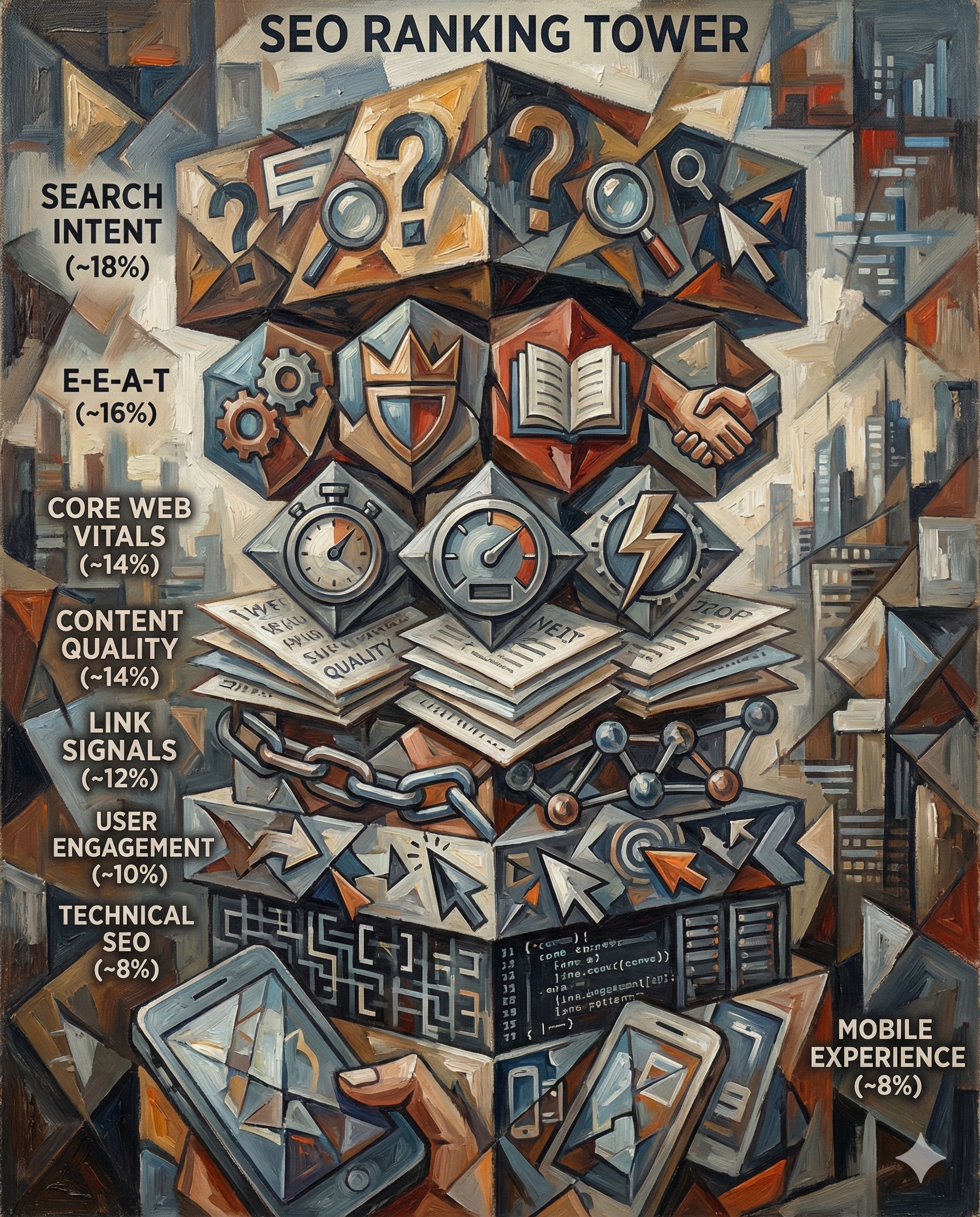
The SEO algorithm evaluates hundreds of signals to rank content, but certain factors carry more weight than others. Understanding these core ranking factors helps prioritize optimization efforts for maximum impact.
| Factor Category | Estimated Weight | Key Components |
|---|---|---|
| Search Intent Match | ~18% | Query-content relevance, user satisfaction |
| E-E-A-T Signals | ~16% | Experience, Expertise, Authoritativeness, Trust |
| Core Web Vitals | ~14% | LCP, FID, CLS performance metrics |
| Content Quality | ~14% | Depth, accuracy, freshness, originality |
| Link Signals | ~12% | Backlink quality, relevance, anchor diversity |
| User Engagement | ~10% | Dwell time, bounce rate, click patterns |
| Technical SEO | ~8% | Crawlability, indexability, structured data |
| Mobile Experience | ~8% | Responsive design, mobile usability |
E-E-A-T (Experience, Expertise, Authority, and Trust) now sits at the heart of how Google rates content. Lily Ray, Senior SEO Director at Amsive Digital, says: "E-E-A-T has become the core of Google's quality checks. Sites that show real know-how and skill beat those that don't."
Per recent local SEO research, sites that nail E-E-A-T see 15 to 20% more views. That means showing author creds, citing solid sources, and building topic depth over time.

Core Web Vitals track how your page feels to real users. LCP (load speed) should be under 2.5 seconds per Google's docs. FID (how fast you can click) should be under 100ms. CLS (layout jumps) should stay below 0.1. For detailed data on how Core Web Vitals, title tags, and content structure impact rankings and revenue, see our comprehensive on-site SEO data analysis based on 18 recent studies.
Mobile matters more than ever. Recent data shows mobile accounts for over 51% of global web traffic. The SEO algorithm uses mobile-first indexing, so Google looks at your mobile site first when ranking. Google has also introduced specialized crawlers like GoogleOther-Image and GoogleOther-Video to index multimedia content more efficiently, requiring specific optimization strategies for images and videos.
Quality signals go past keywords. The algorithm looks at how deep, correct, and fresh your content is. Full answers that truly help users get rewarded.
For technical implementation guidance, Web.dev provides detailed documentation on Core Web Vitals optimization. Backlinko's ranking factors analysis offers data-driven insights into signal importance.
Common SEO Algorithm Mistakes to Avoid
Knowing what the SEO algorithm punishes is just as key as knowing what it likes. Many site owners make moves that hurt their ranks without knowing it.
Keyword stuffing is still a common trap. Keywords matter, but the Google algorithm for SEO spots forced repeats easily. Today's systems care more about meaning than word count. Write for people first. Let keywords flow in a natural way.
Slow sites lose both users and rank. Research shows 53% of mobile users leave if a page takes over 3 seconds. Slow pages tell the SEO algorithm your site isn't worth showing.
Thin, empty content gets hit by the Helpful Content system. Pages made to rank rather than help users get pushed down. The system checks if your content offers real value users can't find somewhere else.
Bad mobile UX kills your other SEO work. With mobile-first indexing, a poor phone layout hurts your rank even if desktop looks great.
Shady backlinks can get you penalized. SpamBrain spots fake link schemes. Earn links by making content worth linking to, not by buying or swapping them.
Missing search intent means you rank for the wrong stuff or not at all. The SEO algorithm pairs content with user goals. A sales page won't rank for "how to" searches no matter how good your keywords are.
For official guidance on what to avoid, Google's Search Essentials documentation outlines spam policies and best practices.
How to Optimize for SEO Algorithms
To win with the SEO algorithm, align your site with what search engines value. Skip shortcuts. Build real trust through quality and fit.
Start with search intent. Before you write, figure out what users really want. The Google algorithm for SEO now cares more about meeting user goals than matching words. Look at top results for your target terms to see what format and depth people expect.
Show E-E-A-T on every page. Prove your hands-on know-how. List author creds and go deep on topics. Earn nods from trusted sources. Build trust with clear info and a secure site.
Speed up your site. Shrink images, cut extra code, use caching, and add a CDN. Check your speed with PageSpeed Insights and fix issues one by one.
Write helpful, fresh content. Recent statistics show around 20.5% of people worldwide use voice search. Write like people talk. Give direct answers, go deep, and share ideas or data users can't get elsewhere.
Earn good links with great work. Make content people want to link to: fresh studies, full guides, and handy tools. Share it with folks who might spread the word.
Stay on top of updates. Sign up for Google Search Central Blog for news. Follow Yoast for tips on how to adapt.
Work with the SEO algorithm, not against it, and you'll see lasting results. If you're ready to implement these strategies yourself, see our practical guide on how to add SEO to your website. Or if you need help building an SEO plan that fits what the system wants, expert SEO help can speed things up.
Key Takeaways
The SEO algorithm is Google's way of linking users with the best content. In 2026 and beyond, winning means getting a few key things right.
AI systems like RankBrain, BERT, MUM, and SpamBrain run modern search. They score quality, fit, and user value at huge scale.
E-E-A-T and Core Web Vitals now drive rank. Show your skill and serve fast, smooth pages to win more views.
Updates won't stop. Marie Haynes, CEO at Marie Haynes Consulting, notes: "Google is getting much better at rating content quality at scale."
Search is shifting. SparkToro says 69% of some searches get zero clicks. You need to grab eyes right in the results, not just on your site.
Make content that truly helps your readers. The SEO algorithm rewards sites that put users first, not ones that try to game the system. For data-driven insights into what actually works, see our comprehensive analysis of on-site SEO factors.
Ready to improve your search visibility? Contact us to discuss your SEO strategy and learn how algorithm-aligned optimization can grow your organic traffic.
Sources
- Google - How Search Works
- Google Search Central - SEO Starter Guide
- Google Search Central Blog
- Moz - Google Algorithm Change History
- Search Engine Journal - Google Algorithm History
- Search Engine Land - Google Algorithm Updates
- Web.dev - Core Web Vitals
- Backlinko - Google Ranking Factors
- Backlinko - SEO Statistics 2026
- DemandSage - Latest SEO Statistics 2026
- Wiser Review - Local SEO Statistics 2026
- Digital Silk - Mobile vs Desktop Traffic Share 2026
- Site Builder Report - Website Speed Statistics 2026
- DemandSage - Voice Search Statistics 2026
- Google Search Essentials
- Yoast - Google Algorithm Updates